With thanks to Esther Lape

Esther Everett Lape was born on October 8, 1881 in Wilmington, Delaware and died on May 17 1981 in her home on East 57th Street in Manhattan. She lived a rich and full life, creating organizations that challenged and changed the world for the better and forming friendships with other women who also challenged and changed the world. Her circle of friends included her life partner Elizabeth Fisher Read, her lifelong friend Eleanor Roosevelt and other lesbian couples who were leaders in the Women’s Suffrage Movement such as Marion Dickerman and Nancy Cook, Molly Dewson and Polly Porter, Grace Hutchins and Anna Rochester.

Esther Lape was a professor of English at Arizona State College, Barnard College, Columbia University and Swarthmore College, who wrote prodigiously, and was the author of many articles on women’s rights and the problems faced by immigrants in the United States.

Her writing attracted the attention of Edward Bok, the former editor of The Ladies’ Home Journal. After World War I, Mr. Bok appointed Miss Lape to head a committee to judge entries in a contest for a ”practical plan to achieve and preserve the peace of the world.” An award of $50,000 was offered for the best plan along with another $50,000 if the plan was accepted by the United States Senate. The committee recommended the award go to a proposal for United States participation in the Permanent Court of International Justice, known as the World Court. 

Mr. Bok incorporated the American Foundation in 1924 to promote the effort. Although the United States Senate never ratified United States participation in the Court, by the time it was dissolved in 1945, the Court had 59 member states.

Esther Lape became the founding director of Bok’s American Foundation for Studies in Government. As part of her work with the Foundation, she published, ”American Medicine – Expert Testimony Out of Court,” a survey of the opinions of doctors, documented the inadequacy of medical care and suggested that improvements in the nation’s medical schools. The publication led to a series of White House meetings and President Franklin Roosevelt’s statement about the rights of every citizen to adequate medical care. She served as director of the American Foundation until she retired in 1955.

In addition to her work for Women’s Suffrage and world peace, Esther Lape knew the value of beauty. She owned a beautiful 147-acre country estate, Salt Meadow, in Westbrook, Connecticut. The estate was a haven for Esther, Elizabeth Reid and Eleanor Roosevelt, a place where they could find solace and sustenance in the midst of the demands of their professional lives. Eleanor Roosevelt wrote many of her My Day newspaper columns there during her frequent visits. In 1972, Lape donated the estate to the Government to be maintained as a wildlife refuge. The Government has seen fit to rename the estate the Stewart B. McKinney National Wildlife Refuge, erasing recognition of Esther Lape’s generosity and ‘Salt Meadow’ her chosen name for the lands. 

I’m tempted to write such has been the lot of women while sadly shaking my head. But I will not. Women work hard, accomplish much, and then are turned into nameless pillars of salt. But no more. It is time to recognize the work of our foremothers. It is time to remember and celebrate their names. Let us wake up each morning and fall asleep each night chanting the litany of names of those who have gone before us. We will stand tall and claim who we are and what we have done, even as we say thank you to the likes of Esther Lape and all of her sisters.

Contextualizing Elizabeth Fisher Read

During leap years, women rise up and claim our power in ways we typically cannot get away with. For example, there is an Irish tradition by which women may propose to men on Leap Day, 29 February, based on a legend of Saint Bridget and Saint Patrick. 1872 was a leap year, and it was an especially auspicious year for women.

Born on January 20, Julia Morgan became an American architect and engineer, who designed over 700 buildings in California during a long and prolific career. She is best known for her work on Hearst Castle in San Simeon, California. Morgan was the first woman to be admitted to the architecture program at l’École nationale supérieure des Beaux-Arts in Paris and the first woman architect licensed in California. She designed many edifices for institutions serving women and girls, including several YWCAs and buildings for Mills College.

On February 4, a great solar flare, and associated geomagnetic storm, made the northern lights visible as far south as Cuba. (OK, this is not obviously auspicious for women, but I personally am enamored with the Northern Lights, and kind of wish I could have seen the display.)

Born on May 10, Victoria Woodhull became the first woman to be nominated for President of the United States, although she was a year too young to qualify and did not appear on the ballot.

Born on October 27, Emily Post was an American author, novelist, and socialite, who became enduringly famous for writing about etiquette.

On November 5, in defiance of the law, American suffragist Susan B. Anthony voted for the first time. On November 18 she was served an arrest warrant, and in the subsequent trial she was fined $100, which she never paid.

Within the context of those births and events, Elizabeth Fisher Read was born on September 8, 1872, in New Brighton, Pennsylvania. She was a woman of her time and a woman ahead of her times, graduating first from Smith College and then from the University of Pennsylvania Law School. In the early 1910s she was active in the women’s suffrage movement, fighting ardently for women’s right to vote. In the 1920s she was a classic example of the 1920s “New Woman”—independent, financially self-supporting, politically active, and socially emancipated.

Read worked as a lawyer for all of her adult life. She was director of research for the American Foundation, a private organization dealing with national and international public affairs issues. She was also a scholar, the author of International Law and International Relations 1926; and the translator of a book on the World Court.

But she was not only a woman who worked. Elizabeth Fisher Read lived with Esther Lape, an educator and publicist, in Greenwich Village, and together they worked for a variety of social and political causes, including the New York state branch of the League of Women Voters. In 1920, Read and Lape were editing the group’s weekly legislative review, City, State and Nation. And it was through that work that Read and Lape first met Eleanor Roosevelt as Roosevelt was working as the director of the league’s national legislation committee. Impressed with one another’s skills, abilities and brains, the three women quickly cemented what became both a political partnership and a warm friendship. Both Read and Lape were Eleanor Roosevelt’s earliest female political and feminist mentors. Among their professional projects was a multiyear effort to encourage American participation in the World Court, an organization created as part of the League of Nations.

In their Greenwich Village home, Read and Lape created an atmosphere that reminded Eleanor Roosevelt of her schooldays with her teacher, Marie Souvestre, and the three women spent many hours there reading poetry and discussing political issues. As first lady, Roosevelt rented a floor in Read and Lape’s building, which she used to escape the pressures of her public position. The three women also spent time at Salt Meadow, the Connecticut country house Read and Lape owned. Read became Eleanor Roosevelt’s personal attorney and financial advisor. Roosevelt regularly consulted both Read and Lape on political issues, from recognition of the Soviet Union to the 1935 Social Security Act.

On December 13, 1943, Read died at the Greenwich Village apartment. 1872 was a very good year for women. 1943, not so much.

If you enjoyed reading about Elizabeth Fisher Read, you might just want to take a look at my novel, Letters from Eleanor Roosevelt, where she words and wisdom along with the words and wisdom of 90 other women are woven throughout the story.

If you enjoy learning about women’s words, wisdom & works, you might enjoy my bimonthly, odd months newsletter, Behold the Women. You can subscribe here.

What were some of your reactions to reading about Elizabeth Fisher Read? What other women did her life call to your mind?

Elinor Morgenthau, who are you?

In Letters from Eleanor Roosevelt I write about a table game called, “who are you?” In the novel, I attribute it to the Roosevelt family as a way they came to know guests at the family dinner table. In truth, it is an ice breaker I would sometimes use when I course I was teaching had a relatively small enrollment. In class, each student would write an answer to the question, “who are you?” I asked the question 10 times, and students responded each time with a different answer. Then we would go around the class and record the responses on the board to get a bird’s-eye view of how we all thought of ourselves. That led to some very interesting discussions. In the (fictional) Roosevelt version of the game, one person volunteered to start, and then each person around the table would query that person, “who are you?” eliciting thoughtfulness and depth in the answers. The game continued rotating the person of focus until everyone responded to the question.

Today I thought I would play a version of that game with Elinor Morgenthau. And so I ask, Elinor

Morgenthau, who are you?

  1. Daughter of Lisette Lehman and Morris Fatman.
  2. Sister of Margaret Fatman.
  3. Wife of Henry Morgenthau.
  4. Mother of Henry III, Robert and Joan.
  5. An athlete who enjoyed tennis and horseback riding.
  6. Alumna of Vassar College.
  7. Teacher of theater at the Henry Street Settlement.
  8. Speaker for the New York State Democratic Committee Women’s Division.
  9. Dear friend of Eleanor Roosevelt and her assistant in the Office of Civilian Defense.
  10. Significant supporter of the War Refugee Board.

Elinor Morgenthau was all of that and more. She was a woman of her time and she was ahead of her times. In 1916, she proposed to her husband in Central Park, New York City. She was a delightful conversationalist, an astute political observer and analyst who supported and advanced her husband’s career and saw to it his appointment as Franklin Roosevelt’s Secretary of the Treasury.

Elinor Morgenthau died of a stroke on September 21, 1949. She was only 57 years old. Eleanor Roosevelt paid tribute to her friend in her September 23, 1949 My Day Column:

For nearly four and a half years, Mrs. Henry Morgenthau, Jr. had been ill at times. She suffered a great deal, but she was a gallant soul.

Elinor Morgenthau loved life and took a deep interest in what was happening in the world as a whole, as well as in what was happening in her own world of family and friends and personal affections. . .

There are not so many good people in the world that we can see their passing without grief for ourselves and regret that their share of humanity’s burdens will now have to be borne by others.

Elinor Morgenthau was many things to many people. She was deeply loved. She was deeply missed in her time. And yet, today her many contributions to our world receive little recognition or appreciation.  Her life, and Eleanor Roosevelt’s thoughts about her life, have me thinking about all the people who have died of COVID in the past years. In the United States, 1.03 million people have died of COVID. In the world writ large, over 6.4 million have died of COVID. For each of those unnecessarily lost lives, we could ask, “Who are you?” We could think about who they loved and how they lived. We should remember, “There are not so many good people in the world that we can see their passing without grief for ourselves and regret that their share of humanity’s burdens will now have to be borne by others.”

Thank You, Alice Hamilton

Get the lead out! An innocent enough mandate when it is simply a call to get moving faster. But in Flint, Michigan, Washington, DC, Newark & Trenton, NJ, Chicago, IL, Baltimore, MD, Philadelphia & Pittsburg, PA, Milwaukee, WI, Boston, MA—get the lead out is a lifesaving remediation that is moving all too slowly to get the lead out, out of their pipes and water systems. Lead poisoning causes learning difficulties, irritability, fatigue, belly pain, constipations, loss of appetite, weight loss, vomiting, hearing loss, premature birth, miscarriage and developmental delays. All of this in the past 20 years. But lead poisoning is not a new issue. The dangers of lead poisoning were clearly and cogently documented in the early 1900s by Doctor Alice Hamilton.

Today I would like to give thanks to Doctor Hamilton for her pioneering, ground breaking and lifesaving work. Let me introduce you to a bit of her life and some of her accomplishments.

Alice Hamilton was born on February 27, 1869 in New York City. She grew up in Fort Wayne, Indiana. She studied medicine at the University of Michigan Medical School, taught medicine at the Woman’s Medical School of Northwestern University and Harvard Medical School. She lived at Jane Addams Hull House for over 35 years. And she died at 101 on September 22, 1970 in Hadlyme, CT.

Oh, but what she did with those 101 years! While she was at Hull House, she treated the local immigrants for diseases that were the consequence of their working conditions. In her autobiography, ‘Exploring the Dangerous Trades’, she said that life in a settlement teaches you that education and culture have little to do with real wisdom, the wisdom that comes from life experience. She personally thrived in the environment of Hull House, observing that “it satisfied every longing, for companionship, for the excitement of new experiences, for constant intellectual stimulation and for the sense of being caught up in a big movement which enlisted my enthusiastic loyalty. At Hull House, Alice Hamilton’s medical knowledge, linked with Jane Addams’ passion for social reform, and the lives for the working-class people, ignited her compassion and indignation. Alice Hamilton brought her education and cultural background to bear on the life experiences she gained at Hull House, and she changed our understanding of health and working conditions to enhance human dignity and public health.

In 1910, the governor of Illinois invited Dr. Hamilton to conduct a study of the extent of industrial sickness in the state. She became managing director of the survey of lead and enamelware industries, rubber production, painting trades and the explosive and munitions industries, with the study of the lead industries as her particular focus. Charles Neill, Commissioner of Labor in the U.S. Department of Commerce, later asked her to conduct a similar survey of all the United States. By the time Alice Hamilton was in her early 40s, she was the leading authority on lead poisoning and one of a very small group of experts in occupational diseases.

Alice Hamilton fully embraced her focus on industrial toxicology, which she described as “scientific in part, but human and practical in great measure.” In each of her investigations, she employed ‘shoe-leather’ epidemiology: careful and extensive analysis of hospital records to document the connection between specific illnesses and occupations, the thorough investigation of factories to learn which industrial processes used or produced dangerous chemicals. But she was not content to document the extent of lead poisoning. She personally tried to persuade factory owners and managers to remedy the dangerous conditions by instituting dust and fume prevention techniques; or by having workers wear protective clothing to be removed and washed at the end of each shift.

Alice Hamilton was a woman of her time and she was ahead of her time. Many of us owe our health and the good health of our relatives to her research and interventions. Thank You, Doctor Alice Hamilton.

{Alice Hamilton is one of nearly 90 women mentioned in my novel: Letters from Eleanor Roosevelt. You can find her there on page 92. Happy Reading!}

What I learned about and from Clover Adams

Last week I wrote about Augustus Saint-Gaudens’ sculpture commemorating Clover (Marian Hooper) Adams. This week I want to write about Clover Adams, the woman. I don’t want to know and remember her only because of the statue that commemorates her death. I don’t want to know and remember her as the wife of Henry Adams. I definitely do not want to know and remember her only as a woman who committed suicide. But what to remember about her?

Which leads to the ubiquitous question, how did we live before the internet and search engines? I can remember, and it was not pretty. So, I fired up my computer, and searched for Clover Adams’ name. Troll as I might, the findings were slim. And then I came across Natalie Dykstra’s biography of Clover, “Clover Adams: A Gilded and Heartbreaking Life.” I struck gold with that find. Here is some of what I learned:

Clover was a practical and quick-witted woman. Henry James described Clover as an ideal specimen of a particular type of American woman: practical, honest, quick thinking with a streak of independence and rebellion. When she was 28, in 1872, she married Henry Adams, who was 5 years older than her. A typical day for the couple included horseback riding in the morning, Henry would take the afternoons for writing, Clover was left to fill that time as she might, then they would serve tea at 5PM for visitors, followed by dinner, and then perhaps an evening ride, a stretch of reading by the fire, dinners with friends or activities supporting various causes.

But Clover battled dark moods throughout her life. She used her wit to maintain perspective and her will to manage people and events around her to suit her needs.

In May 1883, Clover took up photography, both taking and printing her own photographs. She didn’t just take photographs, she made art, and the process changed her life, giving her a new focus and purpose. She reveled in the process: composing the scene, planning and exposing the image, developing the negative, sensitizing the printing paper, making and developing the print—processes that required patience and concentration.

But just as Clover discovered photography as a way to express herself and her creativity, her life started to unravel. Around 1884, Henry evidenced a growing interest in Lizzy Cameron, one of Clover’s friends. It there is no evidence that Lizzy and Henry were ever more than friends, but about that same time Henry began to speak about how he and his wife had grown bored with each other. In April 1885, Clover’s father died. After her father’s death, Clover’s wit deteriorated into sarcasm. By Jul 1885, Clover was profoundly depressed. She lost her appetite and could not sleep. But in late November, she showed signs of improvement and recovery. In early December 1885, Clover committed suicide by drinking from a vial of potassium cyanide, a chemical she used in developing her photographs. The vehicle of her creative release became her pathway to self-destruction.

Clover Adams was a woman who had it all, who had a perfect life rich in family, friends, creativity and the means of enjoying it all. And she stands as a testament to us all that sometimes everything is not enough, that what looks like perfection may in fact be pyrite (fool’s gold).

So, trust your heart, my friends. Be honest with yourself. Stay close to at least a friend or two. When you need some help, ask. Even the hero’s journey includes a mentor/guide/helpmate.

One thing I learned for sure from the Covid years: hugs—warm, cuddly, bear hugs from people you choose—those hugs are precious and life giving.

My encounter with The Peace of God // Grief

On Wednesday February 5, 2020, Washington, DC was enjoying a balmy 50°F, with cloudy skies that were producing an on again off again heavy mist.

(A month later on March 11 the World Health Organization declared Covid-19 a pandemic, on Friday March 13 the President of the United States declared a national emergency, on March 14 CDC issued a “No Sail Order” to all cruise ships, and on March 15 states began to shut down schools, bars, restaurants and places of employment to prevent the spread of COVID-19. We all discovered zoom, grocery shopping online and home food delivery).

But on February 5 was I was blissfully ignorant of what was waiting just beyond the turn of a calendar page.

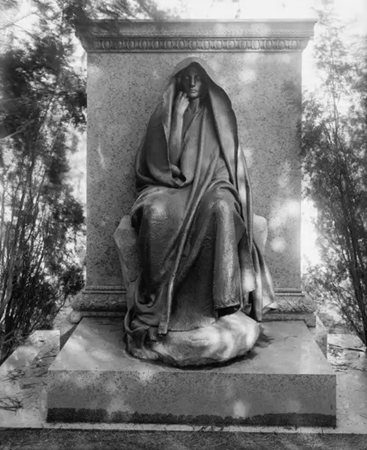
On that Wednesday, we were on a scavenger hunt looking for Rock Creek Cemetery, and for Augustus Saint-Gaudens’ sculpture commemorating Clover (Marian Hooper) Adams.

But why? When I was doing research for my novel, “Letters from Eleanor Roosevelt” I learned that in 1918, during one of the most trying times in Eleanor Roosevelt’s life, when she discovered Franklin had been carrying on with someone else, they were living in Washington DC, and she found great solace in Rock Creek Cemetery. Mrs. Roosevelt spent hours gazing at a statue by Augustus Saint-Gaudens in that cemetery.

Henry Adams commissioned the sculpture in memory of his wife, Clover, who committed suicide. In her book, “Clover Adams: A Gilded and Heartbreaking Life” Natalie Dykstra says that Henry Adams instructed Augustus Saint-Gaudens to take his inspiration from two sources: Michelangelo’s frescoes of the five seated Sibyls in the Sistine Chapel and images of the Buddha, especially Kwannon, the goddess of mercy. Saint-Gaudens notebook for the sculpture notes: mental repose, calm reflection in contrast with the violence or force of nature, beyond pain, beyond joy.

during one of the most trying times in Eleanor Roosevelt’s life, when she discovered Franklin had been carrying on with someone else, they were living in Washington DC, and she found great solace in Rock Creek Cemetery. Mrs. Roosevelt spent hours gazing at a statue by Augustus Saint-Gaudens in that cemetery.

The statue is a hooded figure about 6 feet tall, sitting on a rough-hewn granite block, deep in contemplation. The hood of the cloak drapes over all of the figure except the face. A large slab of polished red marble forms a background for the figure. At a bit of a distance away from the statue, there is a marble bench—the bench where Mrs. Roosevelt sat and contemplated the statue and her own future. There is no plaque on the statue, but Henry Adams called it ‘Peace of God,’ but most people know it as ‘Grief.’

The more that I read about the statue, the more I wanted to see it. It took a little time to convince my wife that this might be a worthwhile adventure, but finally, we were on our way in search of Rock Creek Cemetery and the statue. Neither was easy to find. Neither was well marked, but trusty GPS and persistence got us to both. It was worth the effort. The statue is starkly beautiful, cloaked in an aura of mystery, dignity, and solace. I’m glad that we made the trip. The memory of being in the presence of that statue carried me through the months ahead.

But my searching was not finished. I had to know more about Clover Adams. Usually I can uncover a wealth of information on the internet for the women I blog about here. But not so much for Clover (Marion Hooper) Adams. She was not a very public person. But, you have to be asking, then why did she warrant such a very public and grand memorial? Well, therein lies a story.

To be continued next week.

May I introduce Clare Boothe Luce?

My first experience of Clare Boothe Luce was her toast to Eleanor Roosevelt at Mrs. Roosevelt’s 70th birthday party, “Here’s to Eleanor. No woman has ever so comforted the distressed, or so distressed the comfortable.”

I was smitten. Who was this woman who conceived such an eloquent epigram, encapsulating the essence of Mrs. Roosevelt’s life works? I had to know more!

Ah, the power of reading! I learned that Ms. Luce was an American writer, politician, U.S. ambassador, and public conservative figure. Ah, but she was so much more. I learned that Clare Boothe Luce was born on March 10, 1903, in New York city to William Boothe and Ann Clare Snyder. Both of her parents were involved in the theater, and to help pay the bills, young Clare performed in several plays and did not begin her formal schooling until she was 12. As she grew and matured, Ms. Luce became known for her intelligence, wit, and a knack for publicity that, along with her celebrity and beauty, made her a media darling.

As a young adult, Clare set her sights on writing, the publishers of Condé Nast hired her at Vogue. By 1933 she served as the managing editor at Nast’s Vanity Fair magazine. On November 21, 1935, Clare Boothe married Henry R. Luce, founder of TimeLife, and Fortune magazines. Shortly thereafter Clare Boothe Luce came into her own as a successful playwright.

In 1936 she wrote a Broadway hit, The Women, a satire about the lives of Manhattan socialites that features an all-female cast. The play was made into a movie in 1939 starring Rosalind Russell and Joan Crawford (and was remade in 2008, featuring Meg Ryan and Annette Bening).

Clare began to develop an interest in politics during the Great Depression. When war broke out in Europe, she toured the world as a Life correspondent and reported on countries in Europe, Asia, and Africa and interviewed such famous people as Nehru and Chiang Kai-Shek.

Her first active participation in Republican politics came with her energetic support of Wendell Willkie’s 1940 presidential campaign. By 1942, Connecticut political leaders lobbied Luce to run for a U.S. House seat encompassing Fairfield County and the wealthy town of Greenwich, where Luce had a home. Luce based her platform on three goals: “One, to win the war. Two, to prosecute that war as loyally and effectively as we can. Three, to bring about a better world and a durable peace, with special attention to postwar security and employment here at home.”

Luce won a Connecticut U.S. House seat in 1942, despite never having stood for elective office. She served in the House of Representatives for two terms, the 78th Congress (1943–1945), and the 79th Congress (1945–1947). Though she was critical of President Franklin D. Roosevelt (FDR), Luce’s internationalist bent led her to back the broad outlines of the administration’s plans for the postwar world. She once described her philosophy as, “America first, but not only.” And, despite her status as a leading GOP spokesperson, Luce voted to support the general outlines of FDR’s foreign policy.

On domestic policy, Congresswoman Luce was centrist. In 1943 she supported the Equal Rights Amendment on the twentieth anniversary of its introduction in the House. Luce also endorsed the development of the Women’s Army Auxiliary Corps, arguing that, “We have always been fighting women and never afraid to do our part.” She advocated a heavy wartime tax on the rich: “those who can afford it, the well-to-do and the rich, must be taxed almost to the constitutional point of confiscation.” 

Republican Party leaders selected Luce as the keynote speaker at the 1944 Republican National Convention in Chicago, the first woman so honored by either party.

In 1946 Luce introduced a bill to create a Labor Department bureau to ensure women and minority workers equal pay for equal work. Clare Boothe Luce became the first woman ambassador ever appointed to a major diplomatic post. Luce left Italy in 1956 after suffering arsenic poisoning, and in 1959 she was nominated to be Ambassador to Brazil.

In 1973, Richard Nixon named Luce to the President’s Foreign Intelligence Advisory Board. President Reagan awarded her the Presidential Medal of Freedom, the first woman member of Congress to receive the award.

Clare Boothe Luce died in Washington, DC on October 9, 1987 at age 84 having left her mark on our world, having blazed new trails for the women who would follow stand on her shoulders. She has left us a legacy of strong and sturdy shoulders.

May I introduce Charlotte Perkins Gilman?

Spring is in full bloom and summer is right around the corner. Picnic time is with us. Imagine, if you will, a wide sweeping lawn, with maple and oak trees around the borders that give just enough shade so the sun is not oppressive. Imagine a table set for five. My wife and I, you and your sweetheart, and—and I think this week I would like to invite Charlotte Perkins Gilman to join us.

May I introduce her to you?

Born in Hartford, Connecticut, on July 3, 1860, her mother raised her with the help of Charlotte’s three aunts: Isabella Beecher Hooker, a suffragist; Harriet Beecher Stowe, author of Uncle Tom’s Cabin; and Catharine Beecher, educationalist.

She attended the Rhode Island School of Design, and for a time supported herself as an artist of trade cards (precursors to business cards, with illustrations and information about merchants and their business). She also worked for a time as a painter, a tutor, encouraging others to expand their artistic creativity. During this moment in her life, Charlotte met Martha Luther. Charlotte described their relationship as being: “closely together, increasingly happy together, for four of those long years of girlhood. She was nearer and dearer than any one up to that time. This was love, but not sex … With Martha, I knew perfect happiness …” In these early years of her adult life, Charlotte was happy. Never take happiness for granted.

Charlotte had two husbands and one daughter. Profound postpartum depression followed the birth of her daughter in 1885. Charlotte left much of the raising of their daughter to her first husband, but she maintained an ongoing relationship with her daughter. Charlotte lived life on her own terms, but those terms and that life were not always easy. At one point, Charlotte supported herself by selling soap door to door.

In 1888, she moved to Pasadena, California, with her friend Grace Channing. In Pasadena, her depression began to life. She worked with the National American Woman Suffrage Association, and the International Socialist and Labor Congress, and Nationalist Clubs movement (which worked to “end capitalism’s greed and distinctions between classes while promoting a peaceful, ethical, and truly progressive human race”).

In 1890, the Nationalist magazine published her poem “Similar Cases” (a satirical review of people who resisted social change), and that launched her writing career. 1890 was a watershed year for Charlotte. She wrote fifteen essays, poems, a novella, and a short story.

Between June 6 and 7, 1890, in her home in Pasadena, Charlotte wrote the short story, The Yellow Wallpaper. The New England Magazine printed it a year and a half later in the January 1892. That short story is now the all-time best-selling book of the Feminist Press. In the story, a man rents a cottage for the summer. His wife is trying to deal with her depression, so he locks her in a bedroom, and she, well, she sort of goes crazy. Maybe. Or maybe she finds an alternate reality. If you have not read The Yellow Wall Paper, just stop what you are doing, go to your local book store (or the Feminist Press web page), buy a copy, sit down and read it. It will creep you out. It will make you angry. And it will inspire you to action! (do be careful, reading can do that!).

The short story, The Yellow Wallpaper, is why I want to invite Charlotte Perkins Gilman to our picnic. I really want to know what motivated her to write this story. What was she thinking? How autobiographical was it?

Please do read it—but not when you are alone. Maybe read it on a sunny summer day, on the beach together with some like-minded friends, so you can talk about it with those friends over some hot dogs and s’mores.

Just to finish Charlotte’s life, she published her first volume of poetry, In This Our World, in 1893 and gained public recognition. She eventually became a successful lecturer and her speeches to activists and feminists became a primary source of income.

In 1932, Charlotte learned she had inoperable breast cancer.

In both her autobiography and a suicide note, she wrote that she “chose chloroform over cancer” and she died quickly and quietly on August 17, 1935. Reflecting on death she said, “Death? Why all this fuss about death? Use your imagination, try to visualize a world without death! Death is the essential condition to life, not an evil.”

May I Introduce Cecilia Payne Gaposchkin

Cecilia Payne Gaposchkin is high on my list of people I wish I could invite to a dinner party. She was a diligent, dedicated, hardworking woman and a world class astronomer.

Cecilia Payne Gaposchkin was born on May 10, 1900, in Wendover, Buckinghamshire, England, and died on December 7, 1979 in Cambridge, Massachusetts. And oh, what a life she lived in those 79 years. She was the first person to earn a PhD in astronomy from Harvard University. She was the first woman to become a professor in her department and the first woman to become a department chair at Harvard. In 1976, the American Astronomical Society awarded her the Henry Norris Russell Prize, its highest honor, in recognition of her lifetime of excellence in astronomical research.

But the prizes and accolades at the summit belie the obstructions and obstacles in the climb. Gaposchkin began her academic studies in Cambridge, England, in the 1920s. She prohibited from sitting in the same rows of seats as her male classmates. The University prohibited her from receiving a degree. Even though she fulfilled all the requirements, women were only granted ‘certificates.’

In 1923, she moved to the United States and began her studies at Harvard, where she completed her PhD in 1925. Her dissertation showed that helium and hydrogen were the most common elements in the stars and in the universe. That contradicted the scientific consensus of the time, and her findings were highly controversial. Her work was dismissed, and she took on less prestigious, low paying research jobs at Harvard. But she worked, and she worked in her chosen field. (Her discovery was later credited to Henry Norris Russell of Princeton University, who reached the same conclusion by different means. Gaposchkin’s role in the discovery remained in the background for decades.) But she worked, and she worked in her chosen field. Eventually, she claimed some small measure of recognition.

I highly recommend her autobiography for her personal views on her life, and to taste both her brisk style and her ability to communicate both complexity and nuance.

Reflecting on the way her dissertation findings were treated, Gaposchkin said, “I was to blame for not having pressed my point. I had given in to Authority when I believed I was right. That is another example of How Not To Do Research. I note it here as a warning to the young. If you are sure of your facts, you should defend your position.”
When asked for advice, Gaposchkin often said: Do not undertake a scientific career in quest of fame or money. There are easier and better ways to reach them. Undertake it only if nothing else will satisfy you; for nothing else is probably what you will receive. And yet, there is nothing personal in the thunderclap of understanding. The lightning that releases it comes from outside oneself. Your reward will be the widening of the horizon as you climb. Indeed, the reward of the young scientist is the emotional thrill of being the first person in the history of the world to see something or to understand something. Nothing can compare with that experience. The reward of the old scientist is the sense of having seen a vague sketch grow into a masterly landscape. If you achieve that reward, you will ask no other.

How I wish I could sit with her, share an evening and a glass of wine, and explore the contours of her mind.

May I introduce you to Madame Germaine de Staël?


Who would not want to meet a woman born in 1766, who lived until 1817, who not only survived the French Revolution,  and who Napoleon Bonaparte repeatedly sent into exile!

At a dinner party, Madame Germaine de Stael proclaimed, “Ought not every woman, like every man, to follow the bent of her own talents?” Her familynurtured her formation of opinions such as this from a young age. Madame de Stael’s mother, Suzanne Curchod, ran an extremely well-regarded salon in Paris, entertaining such luminaries as Voltaire and Diderot. She was a woman of letters steeped in the liberal principles of Jean-Jacques Rousseau, and well-read in authors such as Montesquieu, Shakespeare and Dante. These experiences strengthened her intellect and encouraged her emotional intensity. She learned to live her life with a wholehearted enthusiasm, and grew to become a popular salonnière in her own right, captivating foreign dignitaries, liberals, nobles, wives, and mistresses. Her dinners included such personages as Thomas Jefferson, Lafayette, Thomas Paine, and Gouverneur Morris (American envoy to Paris).

Madame de Stael supported the French Revolution in its early days and eventually backed the more moderate elements in the Revolutionary cause. During the French Revolution and the storming of the Bastille, Madame De Staël remained in Paris. She was protected by her relationship with an ambassador, and continued to hold her salon, which was frequented by moderates and monarchists. After the declaration of the French Republic in September 1792, Madame De Staël tried to flee Paris with her full entourage. The crowd stopped her carriage and forced her to the Paris town hall. Robespierre, an influential figure in the French Revolution interrogated her, but eventually, she was allowed to leave the city with a new passport.

For a time, she was constantly on the move, traveling from France to Sweden, Germany and England. Even while she traveled, she was always writing, as she said, “The search for the truth is the noblest occupation of man; its publication is a duty.”

She is generally recognized as a defender of Republican and liberal values: equality, individual freedom – especially for women, and the limitation of power by constitutional rules. She asserted that “Scientific progress makes moral progress a necessity; for if man’s power is increased, the checks that restrain him from abusing it must be strengthened.”

Lord Byron who she met in England, described her as Europe’s greatest living writer, ‘with her pen behind her ears and her mouth full of ink’. He also wrote she was ‘sometimes right and often wrong about Italy and England – but almost always true in delineating the heart, which is of but one nation of no country, or rather, of all.’ Sadly, after travelling in Europe and England she returned to Paris only to die in disillusionment, on Bastille Day, July 14, 1817.

Of all that she said and wrote, I will remember her assertion that “In matters of the heart, nothing is true except the improbable. Love is the emblem of eternity; it confounds all notion of time; effaces all memory of a beginning, all fear of an end.”

Ah, yes. Let there be love.