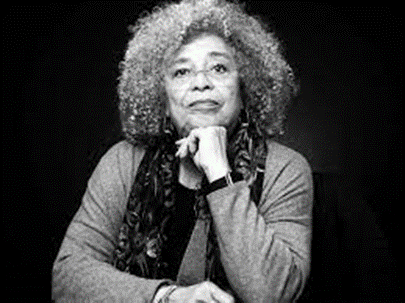
What I learned from Angela Davis

Angela Davis

Angela Davis used to scare me, or maybe it was that she intimidated me. But that is probably not saying as much as it looks like, because there was a time (a long time) in my life when most people intimidated me. Why is a whole other story, more self-confessional than I want to get into here. But I think I’ve mostly grown beyond that now.

But Angela Davis. She really is something. Maybe she still intimidates me some.

She was born January 26, 1944 in Birmingham, Alabama. She graduated from Brandeis University, University of Frankfurt and earned her PhD from Humbolt University in Berlin.  She is a woman of intellect. Some have called her a radical. She says, “Radical simply means “grasping things at the root.”

Angela Davis was a leader in the second wave of feminism, a member of the Black Panther Party and a communist. She ran as the Vice Presidential candidate for the Community Party. She actively campaigned against the Viet Nam war.

Angela Davis taught at various Universities across the United States. She teaches that “We have to talk about liberating minds as well as liberating society.”  And, “You have to act as if it were possible to radically transform the world. And you have to do it all the time.”

She was a supporter of the Soledad Brothers, three inmates who where accused and charged with killing a guard at Soledad prison.  While the three inmates were on trial, one of their brothers secreted guns into the courtroom to help the defendants escape. Melee ensued. The judge and the defendants were shot and killed. A juror and the prosecutor were injured.

Angela Davis had corresponded with one of the inmates and purchased some of the guns. Even though she was not present during the court room melee, she was charged with aggravated kidnapping and first degree murder of the judge. At one point she was on the FBI’s Ten Most Wanted List. She was apprehended, and spent a year in jail before she was found NOT GUILTY on all charges.

Angela Davis has worked persistently for the abolition of prisons and the prison-industrial complex as well as the abolition of the death penalty. In Are Prisons Obsolete? Asserts “[Prison] relieves us of the responsibility of seriously engaging with the problems of our society, especially those produced by racism and, increasingly, global capitalism.”

Angela Davis is a woman of principle and action. In Freedom Is a Constant Struggle she said, “Everyone is familiar with the slogan “The personal is political” — not only that what we experience on a personal level has profound political implications, but that our interior lives, our emotional lives are very much informed by ideology. We oftentimes do the work of the state in and through our interior lives. What we often assume belongs most intimately to ourselves and to our emotional life has been produced elsewhere and has been recruited to do the work of racism and repression.”

Angela Davis is a woman of action and compassion who challenges us to remember, “Whenever you conceptualize social justice struggles, you will always defeat your own purposes if you cannot imagine the people around whom you are struggling as equal partners.”

A message from the Amazons to the Women of the Future

Dear Women of the Future,

We are Penthesilea and Hippolyta. We are Andromache and Antiope. You know us as queens and ruthless warriors. You know us wrongly. Those who control the present have rewritten the past to suit their wants and needs. We are the Mothers. We are a nation of women. We are leaders. We are healers. We are creators. We are weavers and potters. We farm and tend our herds. We are skilled in weapons and wisdom. We are as strong and resilient as need be. And we stand in combat as need be.

You know us as the daughters of Ares, the god of war. We are the daughters of Artemis, goddess of hunting, wild nature, and chastity. We are the daughters of Athena, goddess of wisdom, war and peace, and spinning and weaving. We are who we are, a tribe, a nation of self-sufficient women who stand with strength and pride, and care for our own.

We, the Amazons, are the wild women who inhabit the wild places. Freedom feeds our souls, death trembles before our deeds. We write our holy books, we shape our rules and rituals, we craft heaven from the holiness of our hearts, lives and love.

We the Amazons say to you Women of the Future, choose your battles with the wisdom of your heart, mind and soul. Never give up. Learn each day. Each day do your best to the betterment of your craft and hearth. Face your fears with trembling knees and courage; nature may taunt us with our weakness; our destiny may be poured by a measure beyond our understanding; and yet, goodness will triumph in the end.

Good Women of the Future, you are now the scribes! Take up your words, reclaim the vision of our wisdom, and let our dream and our deeds fade no more. Good Women of the Future, through your actions and voice, the songs of the Amazons, the creativity and courage of wild and willful women will echo ever more symphonically through the valleys of eternity.

(with thanks to Anne Fortier for the inspiration of her book, The Lost Sisterhood)

A message from Alice Paul to the women of the future

Dear Women of the Future,

Wake up girls! There is too much at risk to be napping or resting on our laurels!! Do you not realize how much we who went before you have sacrificed? Do you not realize how long and hard we labored to build the foundations for women’s rights upon which you now stand?

But wait, this is not the tone I intended to take. I do not mean to be a shrew or a nagging elder, but to shine a light on the wealth of opportunities within which you bask. I mean to encourage you to invest in those opportunities, to develop them, to see them grow and multiply.

To those whom much is given, from them much is expected. I know this. I was a child of wealth and opportunity, born in Mount Lauren Township, New Jersey in 1885. I was able to attend Swarthmore College and then I completed my postgraduate studies at the New York School of Social Work. I was even able to study social work further in England where I participated in the women’s suffrage movement. Oh how that shaped and sharpened my skills on protesting tactics. When I returned to the US, I earned a PhD from the University of Pennsylvania, rounding out my credentials. But more importantly, I soon joined the National American Woman Suffrage Association and eventually started my own organization, the National Woman’s Party.

All in all, I have devoted my life to the cause of women’s equality. There are goals yet to be achieved, but our achievements warrant celebration. In 1878 we introduced an amendment to the United States constitution to grant women suffrage, which is to give women the right to vote. In 1878, we women of America proclaimed that America was not a democracy, not when twenty million women are denied the right to vote.

We worked long and hard to gain attention and support for our cause. We organized protests outside the White House, which had never been done before. Our group became known as the Silent Sentinels. We continued our protests continued even when the country was preparing for World War I. After all, when you put your hand to the plow, you can’t put it down until you get to the end of the row. Many of us were jailed multiple times during the protests, we went on hunger strike, and some of us were force fed via a tube. But our determination for equality eventually gained public and political support.

We kept at our work until the amendment was passed by the House of Representatives on May 21, 1919, by the Senate on June 4, 1919. Illinois, Michigan and Wisconsin ratified the amendment within days.  By March 1920 35 states had ratified the amendment, but a core of southern states rejected it. It came down to Tennessee. And the outlook was not good. The vote in the state legislature was 48 to 48. A tie. One representative was yet to vote – Harry T. Burn, a 23 year old Republican, who was known to oppose the amendment. But, his mother wrote to him:  “Don’t forget to be a good boy and help Mrs. Catt (Carried Chapman Catt) put the ‘rat’ in ratification.” He honored his mother’s wish, voted yes, and the 19th Amendment was ratified by the required 36 states on August 18, 1920, and certified on August 26, 1920.

The Nineteenth Amendment simply says: “The right of citizens of the United States to vote shall not be denied or abridged by the United States or by any State on account of sex. Congress shall have power to enforce this article by appropriate legislation.”

I have long believed that there really is nothing complicated about ordinary equality. So, once the vote was secured, we took up the work for a women’s Equal Rights Amendment to the constitution. I could not help but take the next step in our journey to equality out of a feeling of loyalty to our own sex and an enthusiasm to have every degradation that was put upon our sex removed.  I know if we get freedom for women, then they are probably going to do a lot of things that I wish they wouldn’t do. But it seems to me that isn’t our business to say what they should do with it. It is our business to see that they get it. It is not for me to judge the choices of other women, after all, courage in women is often mistaken for insanity. 

Dear women of the future, it is time for you to put your hearts, minds and hands to the plow, to take up the work of women’s equality.  How much longer must women wait to get their liberty? Let us have the rights we deserve.

(the above includes a number of quotes from Alice Paul, woven together and elaborated with words from my heart.)

Seeking the Harmony of Wisdom

There is a story that my grandmother said her grandmother told to her grandmother when she was a child living in the Tatra Mountains in the south of Poland. The story has it that at one point my grandmother’s grandmother’s grandmother’s father was having what we would call a midlife crisis. So, he went off in search of wisdom and the truth. Well, my family are not great adventurers by nature, so, Dziadek (grandfather) Janush walked over to the church and asked the priest where he could find wisdom. The good Father stroked his beard, and told Dziadek Janush to go up into the mountains where he would find a cave with a well near the back of it.

Dziadek came home, packed himself a lunch and set off to find the cave. Late in the afternoon as the shadows were beginning to lengthen, Dziadek found the very cave the good Father at the church had described. So, he went in, found the well, and after walking around the well three times in a clockwise direction, he bowed to the east and poured out the troubles of his heart and asked his question. From the very depths of the well came the answer, “Go down the other side of the mountain to the village crossroads. There you will find what you are seeking.”

With renewed hope and vigor, my Dziadek walked through the mountain pass to the other side of the mountain. He walked down the mountain to a little village he had never been to before, and on to the crossroads at the heart of the tiny village.  There he found three shops. They looked very poor and ramshackle to him. One was selling bits of metal, the second sold wood, and the third sold thin wire. It made no sense to him. What did this detritus have to do with wisdom or truth?

Sad and dejected, Dziadek walked back up the mountain, over the pass and back home again, this time feeling that the parish priest had played some kind of joke on him, and feeling rather foolish. He set out seeking wisdom and had been made a fool of instead. As he walked he cursed the priest. Without thinking he spat out words he had never said before in his life. Then, realizing what he had said, he set off to the Church, found the priest and asked the Father to hear his confession. Dziadek told the good Father all that had happened to him, and how he had been so disheartened and disappointed that he had cursed the priest without even thinking. The priest heard his confession, gave him penance and absolution, and said to my Dziadek, “Be patient my son. You will understand in the future.”

Time went by as time is wont to do. Days turned to weeks. Weeks became months. Months grew into years. And Dziadek settled into his routines and life took on a softness for him and his family. Then one evening Dziadek was walking by the Church rectory where the priest lived and he heard the sound of sweet music coming from the porch.  The music was sweet and haunting and quite wonderful. Dziadek stood there in rapt attention watching the priest play the suka, a Polish fiddle like instrument. The Father’s fingers danced on the strings, he played with masterful concentration and ease. Then Dziadek began to notice the suka itself. It was made of beautiful carved wood, with the strings attached to it with metal pieces. And standing there in the moonlight, watching the good Father play and listening to the music, the light dawned on Dziadek, the suka was made with wood, metal and wire, just like those sold in the stores which he thought were bits of scrap and junk.

Finally he understood the message from the well. We are all always already given everything that we need. Our responsibility is to see the relationships and connections among the elements, to assemble the parts of our lives and use them in the best way possible. Nothing is meaningful when we see only the disparate parts in isolation. But once we put the parts together, we discover the alchemy of synthesis and harmony, a whole new creation comes into being that we could not have foreseen by looking only at each part independently. We must find the synergistic alchemy and interdependence of all of the elements of our lives if we are to live well, if we are to live in harmony with each other and with our environment.

And with that realization fresh in his heart, Dziadek went home to share his thoughts and insights with his dear wife. Anastasia listened thoughtfully to her husband, smiled and said. “Indeed, my dear heart. It is good to know that a tomato is a fruit. It is wise to know that it does not belong in a fruit salad. Even as we learn the nature of each, we must also understand the relationship of one to another and to all. And that my dear is the heart of true alchemy.”

And they did indeed live happily ever after.


The inspiration for this story came from Roger Darlinton’s blog, http://www.rogerdarlington.me.uk/

Ropa Vieja

Bread may be the staff of life, but in my family food was surely the stuff of life. When you walked into my parents home, if you were friend or family (in my parents world, there were family, friends and strangers, if they knew you for 10 minutes and liked you, you were immediately friend); so, if you were family or friend you went to the kitchen where the entire contents of the refrigerator appeared on the table. We all sat and ate and talked. But there was no talking before there was eating. No one ever left my parent’s home hungry! So, I fell in love with the story of ropa vieja the second I heard it.

If you know any Spanish at all, you know that ropa vieja means old clothes. So, what does that have to do with food? Just this: old clothes plus love (lots of love) equals food.

In the Canary Islands, Venezuela, Cuba and Mexico the story is told of a man whose family was coming to visit him. He loved his family deeply and wanted to prepare a grand feast to welcome them to his home. But he was a poor man and could not afford to buy food for them. But he deeply wanted to show them his love and to feed them. So, he went to his closet, gathered some of his favorite old clothes (ropa vieja) and imbued those clothes with his love. He then put the clothes in his stew pot and cooked them with the herbs and some vegetables from his garden.  By the time his family arrived, the clothes turned into a wonderful beef stew!

Alchemy at its best — the nurturing transformative power of love.

And today, Ropa Vieja is a well loved family meal in the Canary Islands, Cuba, Venezuela and Mexico. The dish might (or might not) have chickpeas or potatoes; sometimes it is just the shredded meat (beef, chicken and/or pork) in sauce. It is often made with mint, garlic, tomatoes, onions and green peppers. It is often served with beans and rice and sweet plantains. For families today, ropa vieja is much like old clothes: warm, comforting and familiar.

Love, let us bask in it. May it flow through all of our lives in abundance. May it nurture us body and mind, heart and soul, even as it knits us ever more closely in the hearts and arms of family and friends.

Michelangelo and The Stonecutter

The path to greatness is seldom smooth or straight. Indeed, excellence is a hard won standard. When I think of greatness and excellence in art, Michelangelo is certainly one of the names that fairly quickly comes to my mind. But art was not Michelangelo’s most predictable career, it was his most passionate calling.

On March 6, 1475 Michelangelo was born Michelangelo di Lodovico Buonarroti Simoni in  Caprese in Tuscany, Italy. For generations the men in his family had been bankers, his father was a banker, and everyone expected that Michelangelo would carry on the family tradition, and that he too would make the honorable and respectful choice – that he would become a banker. Banking was in his blood after all. But life is not always predictable. Life is often not predictable.

In 1481, when Michelangelo was 6 his mother became very ill, and died. This was more than his father could bear, and that year Michelangelo was sent to the country to live with a stonecutter and his family. Michelangelo was fascinated with the work of the stone cutter. He was entranced with the man’s ability to step up to the side of a mountain and elicit from it blocks of stone which the man then transformed into shapes and figures. Michelangelo would watch the stonecutter for hours, noticing how he held and used the tools, how he stood and moved in relationship with the mountain.

But Michelangelo was six and had just lost his mother. For a young boy, love and hate are very near neighbors. One day Michelangelo’s grief at his loss of his mother exploded as he witnessed the stonecutter’s happiness. If he (Michelangelo) was miserable and unhappy, it was not fair that this man should have such peace and contentment in his life. (Of course Michelangelo could not have put these words to his feelings, but in later years, he found his way to a similar expression as he thought back on this day.) He raged at the stonecutter. He berated him for his lowly station in life, for the lack of comforts, for the lack of power and influence that the stonecutter had achieved.

The man listened thoughtfully to the young boy. He let him go on until his emotions were spend, and when the anger and run its course and became tears, the stonecutter gathered Michelangelo into his strong arms and hugged him tenderly as if he were his own son. Then he sat down with Michelangelo on his lap and told him this story.

Michelangelo, the things you say to me are nearly true. They are matters that have come to my mind in the past, and I have considered them most carefully, for at one time I was quite dissatisfied with myself and with my position in life.

Then, one day I was walking by a very wealthy merchant’s home. Through the gate and past the door of his house I was more riches than I could ever have imagined. The man had important visitors coming and going all day. “How important and powerful this merchant must be.” I thought to myself. I envied him like no other, and wished that I could be him. Well, to my astonishment, I became the merchant. I was enjoying luxuries and power beyond my greatest dreams. I was envied – and detested – by those less wealthy than myself.

But then the Governor passed by, carried in a sedan chair, accompanied by servants and soldiers and musicians and dancing girls. Everyone bowed before the procession. And I thought, “How important and powerful this Governor is.” I envied him like no other, and wished that I could be a great Governor.

And before I could blink my eye, I was the Governor. I was carried everywhere in a beautiful sedan. I had servants, and guards and musicians. My wishes became commandments, and all bowed before me. And then one day was especially hot, and I became sweaty and sticky and uncomfortable in my chair. I looked up and saw the sun. The sun beamed magnificently in the sky, unaffected by my presence and commands, unaffected by anyone. And I thought, “How powerful is the sun.” And I wished that I could be the sun.

And as soon as I had finished my thought, I was the sun. I was shining brightly, fiercely on everyone. I scorched the fields and dried the ponds, and the farmers and sweating laborers cursed at me. And just then a magnificent storm cloud moved between me and the earth, so that my light could not be seen by anything below. And I thought, “How magnificent and powerful that storm cloud is.” And I wished that I could be the storm cloud.

I became the cloud, and I sent out my rain. I flooded the rivers and the fields. The villagers looked up and shouted at me. And as they did, I could feel myself being moved. It was the wind blowing me away. And I thought, “How powerful the wind is!” And I wished that I was the wind.

And in the instant of that thought, I was the wind. I was a splendid and powerful wind. I blew roofs off houses, uprooted trees. I was feared by everyone. But then I came up against something that I could not move, no matter how I blew against it, no matter how much force and speed I used. It was a huge towering stone mountain. And I thought, “How powerful that mountain is.” And I wished that I could be that mountain.

And, I became the mountain. Standing strong and sure, I was more powerful than anything else on this earth. But as I stood there, I heard the sound of a hammer pounding a chisel into the solidity of my rock. I felt myself being changed. “What could be more powerful than me? I am solid stone?” And I looked down and saw a stonecutter.

And once again I became how I was and always will be.

And Michelangelo snuggled into the stonecutter’s arms and murmured, “I will be who I will always be” even as he held onto the stonecutter’s chisel.

Michelangelo is often quoted as saying, “If there is some good in me, it is because I was born in the subtle atmosphere of Arezzo. Along with the milk of my nurse I received the knack of handling chisel and hammer.” Michelangelo grew to be one of the world’s most respected stonecutters.

with thanks to Benjamin Hoff for his version of the stonecutter in the Tao of Pooh, and to the myriad versions of the Chinese/Japanese/Indian parable on the web.

Please call me by my true names by Thich Nhat Hanh with comments from Ivan M. Granger

I have been in love with this poem by Thich Nhat Hanh for years. Every time I read it I am touched more deeply by the implications of the poem, by its call for compassion and justice. By its demonstration of the inherent unity of all that is, of all of us. And then recently I cam across a discussion of the poem by Ivan Granger. Beautifully said, Ivan (who I don’t know — yet). so, I thought I would share both with you all … think deeply, please.  … Mary

Please Call Me by My True Names

by Thich Nhat Hanh (1929 – )

 
Don’t say that I will depart tomorrow —
even today I am still arriving.

Look deeply: every second I am arriving
to be a bud on a Spring branch,
to be a tiny bird, with still-fragile wings,
learning to sing in my new nest,
to be a caterpillar in the heart of a flower,
to be a jewel hiding itself in a stone.

I still arrive, in order to laugh and to cry,
to fear and to hope.

The rhythm of my heart is the birth and death
of all that is alive.

I am the mayfly metamorphosing
on the surface of the river.
And I am the bird
that swoops down to swallow the mayfly.

I am the frog swimming happily
in the clear water of a pond.
And I am the grass-snake
that silently feeds itself on the frog.

I am the child in Uganda, all skin and bones,
my legs as thin as bamboo sticks.
And I am the arms merchant,
selling deadly weapons to Uganda.

I am the twelve-year-old girl,
refugee on a small boat,
who throws herself into the ocean
after being raped by a sea pirate.
And I am the pirate,
my heart not yet capable
of seeing and loving.

I am a member of the politburo,
with plenty of power in my hands.
And I am the man who has to pay
his “debt of blood” to my people
dying slowly in a forced-labor camp.

My joy is like Spring, so warm
it makes flowers bloom all over the Earth.
My pain is like a river of tears,
so vast it fills the four oceans.

Please call me by my true names,
so I can hear all my cries and my laughter at once,
so I can see that my joy and pain are one.

Please call me by my true names,
so I can wake up,
and so the door of my heart
can be left open,
the door of compassion.

1989

— from Call Me by My True Names: The Collected Poems of Thich Nhat Hanh, by Thich Nhat Hanh

 
Commentary by Ivan M. Granger

This is a lovely, unflinching meditation on how all of being and all of human experience weaves together into a single tapestry of the whole. It can even draw comparisons with Walt Whitman’s “Song of Myself,” where everything, terrible and beautiful, is one, is witnessed, and is found within oneself. 

Don’t say that I will depart tomorrow — 
even today I am still arriving.

Most of us have learned to anticipate what will happen next, and we end up mentally dwelling in our fantasies and fears about the future. But the future is merely an idea; it never has reality. The present moment is all that is ever real. And that is where we must dwell if we want to truly be alive and know what is real.

The present is a state of “still arriving.” Because the present moment is not a fixed space in time, you can’t say that anything encountered in the present is fixed and settled either. The present is a gossamer thin and moving point of light where all things are just barely stepping into the visibility of being… as the moment keeps moving. Everything, everyone, in every second is always just arriving. The present is a continuous becoming. 

Look deeply: every second I am arriving 
to be a bud on a Spring branch, 
to be a tiny bird, with still-fragile wings, 
learning to sing in my new nest…

Another fascinating thing is discovered when we truly, deeply perceive the present moment: Not only are we and all things “still arriving,” but the illusion of boundaries and separate being falls away. The notion of identity expands and recognizes itself just as naturally in all things witnessed. We find we are not just the person watching the bud on the Spring branch, but in our arriving we are equally the Spring bud, the young bird, the caterpillar in the flower, the jewel waiting in the stone. This is not some poetic game of words; it is what we actually perceive.

The rhythm of my heart is the birth and death 
of all that is alive.

When we finally see this truth then, for the first time, we can truly witness the world as it is. And that is what this poem is most about: witnessing. Thich Nhat Hanh invites to courageously witness the panorama of life, wonders and horrors alike. Through this form of true witnessing, we are not spectators watching others from a distance; no, it all unfolds upon us and in us. We are witnessing ourselves in many forms. We recognize that anything that happens anywhere in the world, is truly happening to ourselves and no other. And everything done, is done by ourselves and no other.

Please call me by my true names, 
so I can wake up, 
and so the door of my heart 
can be left open, 
the door of compassion.

This is why compassion is not altruistic and service is no effort. When we finally see things as they are, it is all oneself. When we offer our heart, when we offer our hand, we are simply helping ourselves. Who among us, when he touches a hot iron, doesn’t immediately pull back and then soothe the burn under cool water? That’s not altruism, it is the natural response to pain in one’s body. When we see clearly, we see we are all of one body, and the joys and pains of any other is yours as well. 

Compassion and an open heart are the natural result of being awake to this truth, and no effort at all.

Happy Easter, Happy Season of Greening, Manifesto: the mad farmer liberation front

today is Easter. We decided to go to church to honor the moment and to re-member. It was the right choice.

The gathering words were taken from a poem by Wendell Berry. The words seemed so right, I thought I would share them with you. I hope they are as meaningful for you as they are for me.

Manifesto:
The Mad Farmer Liberation Front

by Wendell Berry

Love the quick profit, the annual raise,
vacation with pay. Want more
of everything ready-made. Be afraid
to know your neighbors and to die.

And you will have a window in your head.
Not even your future will be a mystery
any more. Your mind will be punched in a card
and shut away in a little drawer.

When they want you to buy something
they will call you. When they want you
to die for profit they will let you know.
So, friends, every day do something
that won’t compute. Love the Lord.
Love the world. Work for nothing.
Take all that you have and be poor.
Love someone who does not deserve it.

Denounce the government and embrace
the flag. Hope to live in that free
republic for which it stands.
Give your approval to all you cannot
understand. Praise ignorance, for what man
has not encountered he has not destroyed.

Ask the questions that have no answers.
Invest in the millenium. Plant sequoias.
Say that your main crop is the forest
that you did not plant,
that you will not live to harvest.

Say that the leaves are harvested
when they have rotted into the mold.
Call that profit. Prophesy such returns.
Put your faith in the two inches of humus
that will build under the trees
every thousand years.

Listen to carrion — put your ear
close, and hear the faint chattering
of the songs that are to come.
Expect the end of the world. Laugh.
Laughter is immeasurable. Be joyful
though you have considered all the facts.
So long as women do not go cheap
for power, please women more than men.

Ask yourself: Will this satisfy
a woman satisfied to bear a child?
Will this disturb the sleep
of a woman near to giving birth?

Go with your love to the fields.
Lie down in the shade. Rest your head
in her lap. Swear allegiance
to what is nighest your thoughts.

As soon as the generals and the politicos
can predict the motions of your mind,
lose it. Leave it as a sign
to mark the false trail, the way
you didn’t go.

Be like the fox
who makes more tracks than necessary,
some in the wrong direction.
Practice resurrection.

“Manifesto: The Mad Farmer Liberation Front” from The Country of Marriage, copyright ® 1973 by Wendell Berry, reprinted by permission of Harcourt Brace Jovanovich, Inc.

Poetry, Power and Suheir Hammad’s talisman

There is a child’s nursery rhyme that is often quoted: sticks and stones will break my bones, but names will never hurt me.  But, there is another version of that rhyme that says: sticks and stones will break my bones, but names will kill my soul.  … naming is powerful. Words are powerful. Poetry is powerful.

Thomas Merton wrote, “art [poetry] enables us to find ourselves and lose ourselves at the same time.” When I read poetry, when I hear it, when I feel its resonance in my heart, in the depth of my being it touches, it changes, it evokes the best in me. Poetry embodies the alchemy of transmogrification to ways of being that celebrate human dignity, that create social structures that embody justice. 

Suheir Hammad writes poems of war, peace, women, power – she claims human dignity and a just world. Her writing is a talisman for me. She wrote a poem that titled talisman … feel its power …

talisman
it is written
the act of writing is
holy words are
sacred and your breath
brings out the
god in them
i write these words
quickly repeat them
softly to myself
this talisman for you
fold this prayer
around your neck fortify
your back with these
whispers
may you walk ever
loved and in love
know the sun
for warmth the moon
for direction
may these words always
remind you your breath
is sacred words
bring out the god
in you

Give a listen to her TED Talk. (If you have not explored the TED web page, really go surf over there. TED: Technology, Entertainment, Design – ideas worth spreading. And it really is a great collection of ideas worth exploring). So, here is the link to Suheir Hammad reading a couple of her poems http://www.ted.com/talks/suheir_hammad_poems_of_war_peace_women_power.html

may you walk ever loved and in love!

may we all know days of warmth

and peace

and love

On the day we acknowledge Dr. King & toward the day we acknowledge human dignity

Today, January 21, 2013 is the day that the United States has deemed to remember the birthday of Dr. Martin Luther King, Jr.  We remember him in recognition of his work to end – well to challenge – racism within the United States of America.  That is a work in progress for sure.  In lots of places you will find his “I have a dream” speech.  It is an important speech. You should go read it.

Here, today, I wanted to share with you two of my favorites for thinking about and challenging racism. One is a poem by Pat Parker… it names and plays with stereotypes that so many white people hold about people of color. It plays with the struggles white people manufacture when we finally try to get over ourselves and open to developing relationships with people of color – as if that is the great gift all people of color have been waiting for all their lives (maybe, just maybe no so much!).

The second excerpt is the White Privilege Inventory that has been developed from Peggy McIntosh’s essay on Unpacking White Privilege.  … Because so many white people still think it is an even playing field.

So, read the poem, please. Think about it with an open heart. … of course she’s angry. And she is also laughing, I think.  Then fill in the inventory. Just how many privileges do you enjoy?  And, then … take one little step outside of your comfort zone. Do some little thing to make this world of ours a bit more fair, a bit more respectful of the dignity of ALL sentient beings, a bit more compassionate?

Pat Parker poem – ” For the White Person Who Wants to Know How to Be My Friend”?
The first thing you do is to forget that i’m Black.
Second, you must never forget that i’m Black.

You should be able to dig Aretha,
but don’t play her every time i come over.
And if you decide to play Beethoven–don’t tell
me his life story. They made us take music
appreciation too.

Eat soul food if you like it, but don’t expect me
to locate your restaurants
or cook it for you.

And if some Black person insults you,
mugs you, rapes your sister, rapes you,
rips your house, or is just being an ***–
please, do not apologize to me
for wanting to do them bodily harm.
It makes me wonder if you’re foolish.

And even if you really believe Blacks are better
lovers than whites–don’t tell me. I start thinking
of charging stud fees.

In other words, if you really want to be my
friend–don’t make a labor of it. I’m lazy.
Remember.

RACIAL INVENTORY

Score 5 if statement is always true for you

Score 3 if the statement is sometimes true for you

Score 0 if the statement is seldom true for you

Because of my race or color …

1. _____ I can be in the company of people of my race most of the time.

2. _____ If I should need to move, I can be pretty sure of renting or purchasing housing in an area in which I would want to live and which I can afford.

3. _____ I can turn on the television or open the front page of the paper and see people of my race widely and positively represented.

4. _____ When I am told about our national heritage or about “civilization,” I am shown that my people made it what it is.

5. _____ I can be sure that curricular materials will testify to the existence of my race.

6. _____ I can go into most supermarkets and find the staple foods that fit with my cultural traditions.

7. _____ I can go into any hairdresser’s shop and find someone who can cut my hair.

8. _____ Whether I use checks, credit cards or cash, I can count on my skin color not to work against the appearance of financial reliability.

9. _____ I can swear, dress in second hand clothes, or not answer letters, without having people attribute these choices to the bad morals, poverty or illiteracy of my race.

10. _____ I can do well in challenging situations without being called a credit to my race.

11. _____ I am never asked to speak for people of my race.

12. _____ I can criticize our government and talk about how much I fear its policies and behavior without being seen as a cultural outsider.

13. _____ I can be pretty sure that if I ask to talk to the “person in charge,” I will be facing a person of my race.

14. _____ I can conveniently buy posters, postcards, picture books, greeting cards and children’s magazines featuring people of my race

15. _____ If a traffic cop pulls me over, I can be sure I haven’t been singled out because of my race.

16. _____  I can go home from most meetings of the organizations I belong to feeling tied in rather than isolated, out of place, outnumbered, unheard, feared, or hated.

17. _____ I can take a job with an affirmative action employer without having co-workers on the job suspect that I got it because of race.

18. _____ I can choose public accommodation without fearing that people of my race cannot get in or will be mistreated in the places I have chosen.

19. _____ I can be sure that if I need legal or medical help, my race will not work against me.

20. _____ If my week or year is going badly, I need not wonder if each negative episode or situation has racial overtones.

21. _____ I can comfortably avoid, ignore or minimize the impact of racism on my life.

22. _____ I can speak in public to a powerful group without putting my race on trial.

23. _____ I can choose blemish cover bandages in “flesh” color and have them more or less match my skin.

_____  TOTAL

adapted from Peggy McIntosh “White Privilege: Unpacking the Invisible Knapsack”