About My Obsession with Creation Stories

In the last few blog posts, I’ve written my versions of a few creation stories. Today, I want to take a step back and think with you about creation stories.

I’ve been wondering about my obsession with creation stories. What is it that draws me to them? Well, as I look at the world around me, especially while I am on Cape Cod, I am overtaken by vastness of the ocean and the sand dunes. The endless motion of the ocean waves, the immensity of that much water! I’m silly enough to wonder how many grains of sand there are in one dune, let alone the endless, undulating sweeps of dunes in the National Seashore.

How did this all come to be? Why this and not something else? Why here? And how did we come to talk about the beginnings the way we do? When I wonder about how it all came to be, I wonder even about the beginnings of the beginnings. Could there have been a time, a moment when there was nothing? Just nothing? And then what happened? Who made it happen? How? When? Why?

Or were there always some kinds of beings? Goddesses and Gods who got bored one day and talking among themselves, maybe a bit tipsy on some wine (surely if there were Goddesses and Gods there must have been wine), so maybe they said, “let’s create something to entertain us.” And maybe that kind of thing is how the world came to be.

So I started to read about types of creation stories, and sure enough, there are stories that describe creation from nothing. The creator breathes, thinks, dreams, speaks, laughs, even listens the universe into being—creation ex nihilo—from nothing. One of my favorite groups of creation stories is those where the creator is a craftsperson, who intricately and cleverly shapes all of everything from a primordial substance. One of my other favorite groups of stories are the earth diver stories—there is a pre-existing great sea, a creator sends a creature into the sea to find material, and from the tiniest bit of substance, creates the world—these are just fun stories. And let me not forget emergence stories—there is a pre-existing world which becomes too small or confining, and the people find a way to emerge into a new and grander world. Then there are also stories where two creators bring the universe into being through conflict between them—these stories often spell out hierarchies and class structures. And, and, and. Some folks will detail out nine different kinds of creation stories!

So many kinds of stories. So many possibilities. And to think for so many years I thought the Book of Genesis was the first and last word on all of this! Wow.

cosmic egg

Tibetan Bon cosmic egg creation myth

Bon is an indigenous Tibetan religion with a rich cosmology. The Bon creation story includes not one but two cosmic eggs. I am still struggling with the way many creation stories deal with good and evil, but the Bon story feels nicely balanced to me—maybe because of my affinity for Asian philosophies and Buddhism. This particular cosmic egg story presents us with a narrative of the origin of the universe and the birth of cosmic order from chaos. It doesn’t deal in great detail with the particulars of the creation of the earth and the creatures of the earth, but there are lots of other creation stories that will take us on that ride. If you are looking for a primary source for this story, the Bon myth of the origin of existence is narrated in detail in the Treasury of the Origin of Existence. Here’s my version of it.

The Origin of Existence and the Cosmic Egg

In the beginning, before time and being, there was primordial potentiality. From that potentiality, in the dimension of open and waiting space, thanks to the power of the Immortal, the air element and the winds emerged. The movement of the winds produced a vortex of light that whirled vigorously. The energy of the winds discharged heat, and the fire element formed.

From the cold vapor of the wind and the burgeoning heat of the fire element, water formed as dew and rime (frost on cold objects created by the rapid freezing of water vapor in clouds and fog). Minute particles of matter condensed on those waters, creating the earth element. Those particles, shaken and blended by the wind whirling swiftly in space, formed the earth and its mountains.

From the interaction of the essences of the five basic elements—space, air, fire, water, earth—two cosmic eggs came into being, an egg of light and an egg of darkness.

Through the power of the Luminous Immortal One, from the pure essence of the five elements the Luminous Egg of Light formed, with four fates and eight corners, the size of a seven-year-old female yak. From the power of the Infinite Non-Being, the Cosmic Egg of Darkness formed, with three corners, the size of a three-year-old bull.

The Luminous Egg hatched by the force of its own light, and from the clear light that spread in space were born the numerous deities, beings of light who took on the task of protecting virtuous actions. From the Luminous Egg emerged the Ancestor and Ancestress of the human race, and the Deities who took on the task of sustaining compassion and virtue.

The Cosmic Egg of Darkness hatched in the dimension of black light and emitted obfuscation, obscuration and madness. From the Cosmic Egg of Darkness, beings were born who delighted in annihilation, emptying, interruption and destruction.

In that way, good and evil were born, the earth and all of its beings were created, bringing order to the chaos of unformed potentiality.

Who are you?

I’m reading Braving the Thin Places: Celtic Wisdom to Create a Space for Grace by Julianne Stanz. It may be a little too “capital C” Catholic for my preference at the moment, but it is none the less a splendid book, rich with prompts that inspiration self-reflection. It is the Celtic version of spiritual Japanese Kintsugi, the art of repairing broken pottery with gold, a process that transforms the damaged areas into streams of strength and resilience marking the paths of our learning and growth.

In the first chapter, Julianne Stanz poses the question, “who are you?” She reflects on a moment when one of her teachers asked her, “who are you?” and then encouraged her to go beyond behaviors, beyond relationships, beyond the choices we make, even while recognizing that those are important elements within our story.

Reading those lines in the book, I couldn’t help but remember how I used that very question as an icebreaker in so many of the courses that I taught in Human Behavior. I remembered how I used that question as a blessing at the birth of one of the main characters in my novel, Letters from Eleanor Roosevelt. “Who are you?” is a question with deep resonance in my life.

Julianne Stanz’s teacher encourages her to dig deeper, to think about who she really is. There are some lines in the Celtic Kildare Poems that encourage us to always remember in our heart these three things related to the nature of our being:

Whence you come.

Who you are.

What shall become of you.

I believe that remembering those there things and reflecting on them has the potential to carry us deeper into self-awareness. Now, to be honest, committing to self-awareness is tricky. There can be a fine line between self-awareness and self-centeredness. But especially for women of a certain age, walking on the right side of that line is a journey worth taking. I remember my early days dancing on the fringes of the second wave of feminism, and my growing awareness of how our culture socialized women to be selfless. It’s hard to be self-centered when you are self-less. it’s also hard to be self-aware when you are self-less. For many of women, finding and nurturing a healthy sense of self is necessary.

And then because my brain is my brain, I remembered the Zen koan, “What is your original face? What is the face you had before you were born?” A koan intended to set the meditator on a quest to encounter a deeper understanding of oneself, a quest to engage with one’s true, unconditioned nature. Not to give away the answer, but some writings say that our original nature is luminous, and pure, unbound by any specific form or possession.  

What is your original face? What is the nature of your self? Who are you? I say each and every one of us is pure, luminous love. I say we, and all of creation, come from love. We are called to live love, and we will return to love. Not love the flighty emotion, but love the active verb. The Love that sees the goodness in self, others and all of creation. The Love that wills and acts to enable that goodness to grow. That’s who I think you are, and I am too.

Let this Darkness be a Bell Tower

We live in interesting times, maybe a bit too interesting for my taste. But I’m working on accepting reality as it is, even as I work as best I can for a better tomorrow. After all, what choice do we have? Accept the moment, or bang our heads against the wall and give ourselves a case of anxiety and a concussion.

That being the case, I take heart from this poem by Rainer Maria Rilke. It reminds me to inhale, exhale, repeat as necessary. It reminds me of the power and expansiveness of breathing, of beauty rendered from brokenness. It reminds me of the Japanese art of Kintsugi, repairing cracked pottery with gold, by gluing the broken pottery pieces together with a lacquer dusted with gold powder, highlighting the cracks rather than hiding them. Wasn’t it Hemingway who said, “The world will break you. Then you become strong in the broken places.” Well, I’m just sayin’ that after this year, we all are likely to be strong in a whole lot of places…

Let This Darkness Be A Bell Tower

Rainer Maria Rilke

translation by Joanna Macy + Anita Barrows

Quiet friend who has come so far,
feel how your breathing makes more space around you.
Let this darkness be a bell tower
and you the bell. As you ring,

what batters you becomes your strength.
Move back and forth into the change.
What is it like, such intensity of pain?
If the drink is bitter, turn yourself to wine.

In this uncontainable night,
be the mystery at the crossroads of your senses,
the meaning discovered there.

And if the world has ceased to hear you,
say to the silent earth: I flow.
To the rushing water, speak: I am.

Sonnets to Orpheus II, 29

From his last “Sonnet to Orpheus,” Joanna Macy tells us that Rilke has chosen to be with the darkness rather than hide from it. For Macy, that deeply resonates with our relationship to our planet. Yes to that, and I find it also resonates deeply with our current political climate.

Celebrating the 4th of July and the letter ‘R’

All of the current Fourth of July celebrating reminds me of a story

In the late middle ages there was a cloistered order of Catholic nuns, the Sisters of the Loose Habit. During one of their annual meetings, one of the novices, who was close to taking her final vows, asked about the order’s inclusion of celebacy as one of the three vows each of the sisters pledged. (The three vows were poverty, celebacy, and obedience.)

The elder sisters admitted they were not aware of the origins of the vows. It was just the way things had always been. For centuries, it had been that way. It was tradition.

So, they all agreed that Elder Sister Agnes, the chief scribe in charge of keeping the order’s records up to date, would go back into the archives, back to the original documents detailing the founder’s intentions, and see what she could find. The archives were kept in an ancient cavern beneath the chapel. Sister Agnes and her junior assistant entered the cavern early the next morning. 

The sisters waited. The hours passed. As night came on, the anxiously waiting sisters heard weeping and then wailing coming from the cavern. The waiting sisters became even more anxious, fretting about what might be happening with Sister Agnes. But they had all agreed that only Sister Agnes and her assistant would enter the cavern. So they waited. Finally, Sister Agnes & her assistant emerged from the cave, covered in dirt, wracked with tears, sobbing. 

The other sisters asked Sister Agnes what was troubling her? What did she discover in the cavern? Did it have anything to do with the origins of celibacy?

Sister Agnes replied, “Several hundred years ago, one of the order’s scribes was copying the order’s original documents, as those documents were deteriorating. In recopying the documents, the sister wrote ‘celebate’ in the new document and left out the ‘R’!!!”

Indeed! Joy and Celebration are part and parcel of holiness, as much as mercy and justice!

Happy Fourth, one and all!!

Maybe silence can be golden

This post has been moved to Marys Book Bog. Please surf over there.

I’m sorry for any inconvenience. I initially posted it in the wrong place.

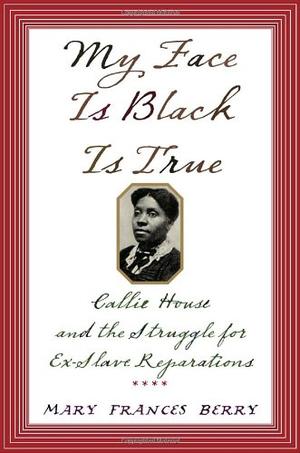
I would like you to meet Callie Guy House

Of all the women, living and dead, that I might invite to a dinner party, Mrs. Callie Guy House (Born approximately 186, died 1928) is at the top of my list. Mary Frances Berry introduced me to Mrs. House in her biography of this amazing woman, My Face Is Black Is True: Callie House and the Struggle for Ex-Slave Reparations. Let me just say right up front, you should go read the book! Mary Frances Berry makes history come alive. She will make you wish you could claim Callie House as your ancestor.

Here are some highlights from Mrs. House’s life story.

Mrs. House was born a slave, died a free woman. She was in Tennessee in January 1865 when William Tecumseh Sherman issued his order for each adult freed male slave to claim 40 acres. She cheered when the Freedman’s Bureau promised each freed man 40 acres and then wept when President Jackson pardoned the rebels and restored their lands to them, taking away the possibility of land for freed slaves.

Along with Mr. Isaiah Dickerson, Mrs. House championed the ex-slave movement. Forty acres and one mule for three hundred years of hard work with no pay—that was not too much to ask. Mrs. House and Mr. Dickerson argued that if the government had the right to free the slaves, then the government had a responsibility to ensure provisions for them. She argued that our government made promises at Emancipation and those promises should be fulfilled.

In 1896, House and Dickerson formed the National Ex-Slave Mutual Relief, Bounty and Pension Association. Mrs. House must have been a force of nature as she held forth on the needs and the rights of the ex-slaves. She traveled all over the south talking to groups of freed slaves. She talked to people who were struggling to keep body and soul together. She listened to people who were turned loose — People who were illiterate, barefooted, and naked without a dollar or a pocket to put it in; people who were free but with no place to go for shelter from the wind and rain. She listened to people who were free from the man who once had the power to whip them to death, but who were still dependent on that same man who now had the power to starve them to death. Today, we argue for freedom as a prized state of being. But for the people Callie House met with, freedom meant loss. The Ex-Slave Association gave them hope. They contributed monthly dues and helped each other out with illnesses and with burials. They sent petitions to Congress. Their petitions went unanswered. 

The late 1890s were many things, but they were not a time of benign neglect. In 1899, the Post Office issued a fraud order against the National Ex-Slave Mutual Relief, Bounty and Pension Association and its officers. The Post Office said that the Association and the officers could no longer use the mail because they were collecting moneys for fraudulent purposes. The Post Office kept obstructing their work. They made it difficult to collect the dues that kept the offices running. They made it difficult to put out newsletters and notices to the members. Even so, the Association found ways to struggle along. They used Wells Fargo and American Express. They used their brothers’ and sisters’ names.

But institutions are resilient and persistent and have power. On August 1916, the police arrested Mrs. House. For 20 years, she exercised her constitutional right to petition the government and taught other ex-slaves to do the same. But the Post Office accused her of using the mail to defraud people. They sent her to prison for a year. Callie House was resilient and persistent. But human beings have limits. By the time she got out of prison, the association was dead. Mrs. House was free, but she was too broken and too tired to do more than take in washing and sewing. She earned barely enough to put food on her plate. It was time for others to take up her cause. It IS time for others to take up her cause.

Introducing Bella Savitzky Abzug

Ah, my friends, if you don’t know her, or know about her, let me introduce you to Bella Abzug.  The first thing that comes to my mind when I think about her is ‘hats.’   Before Madeleine Albright claimed pins/ brooches as her signature wardrobe statement piece, Bella Abzug flaunted her hats, “I began wearing hats as a young lawyer because it helped me to establish my professional identity. Before that, whenever I was at a meeting, someone would ask me to get coffee.” If you google search images of Bella Abzug, 99.44% of the images show her wearing a hat. Oh, but she was so much more.

The second thing that I think of when I think of Bella Abzug is activism—for civil rights, for feminism, and against the political establishment even as she served the state of New York in the United States House of Representatives for three terms, from 1971 through 1977. She was a woman who spoke her mind, loudly and proudly.  She ran her campaigns on an antiwar, pro-feminist platform with the slogan, “This woman’s place is in the House … the House of Representatives!”

Writer Norman Mailer once described Abzug’s voice as an instrument that “could boil the fat off a taxicab driver’s neck.” She knew that her personality irritated some and inspired others, but Abzug had a backbone of titanium. In response to Mailer she said, “I’ve been described as a tough and noisy woman, a prize fighter, a man-hater, you name it. They call me Battling Bella, Mother Courage, and a Jewish mother with more complaints than Portnoy. There are those who say I’m impatient, impetuous, uppity, rude, profane, brash, and overbearing. Whether I’m any of these things or all of them, you can decide for yourself. But whatever I am—and this ought to be made clear from the outset—I am a very serious woman.”

And that my friends is what I want to be when I grow up—a very serious woman, with a clear sense of self, and an steadfast sense of humor.

A few facts:

1920, July 24 Born Bella Savitzky in the Bronx, New York.

1944 (maybe 1945?) Married Martin Abzug. They raised 2 daughters.

1942 Earned a bachelor’s degree from Hunter College

1947 Earned her LLB (law degree) from Columbia University Law School

Early 1950s (During the McCarthy era) she was one of the few attorneys willing to fight against the House Un-American Activities Committee.

1961 cofounded Women Strike for Peace, a group that protested the nuclear arms race and, later, the American military commitment in Vietnam.

1970 ran for political office—she was 50.

1974 the first national legislator to introduce a bill to increase the rights of gay Americans; the bill proposed amending the Civil Rights Act of 1964 “to prohibit discrimination on the basis of sexual or affectional preference.”

1990 co-founded the Women’s Environment and Development Organization (WEDO), an international activist and advocacy network.

1998, March 16—gave her final public speech before the UN in March.

1998, March 31— after battled breast cancer, died on in New York City from complications following open heart surgery.

Here’s a bit of Bella Abzug in her own words:

Women’s struggle for equality worldwide is about more than equality between men and women. Our struggle is about reversing the trends of social, economic, political, and ecological crisis a global nervous breakdown! Our struggle is about creating sustainable lives and attainable dreams.  

I always had a decent sense of outrage.  

Women have been trained to speak softly and carry a lipstick. Those days are over.

We are coming down from our pedestal and up from the laundry room.  

Maybe we weren’t at the Last Supper, but we’re certainly going to be at the next one. 

The test for whether or not you can hold a job should not be the arrangement of your chromosomes.

 Our struggle today is not to have a female Einstein get appointed as an assistant professor. It is for a woman schlemiel to get as quickly promoted as a male schlemiel.

Meet Anne Bradstreet Poet of the Massachusetts Bay Colony

This week I would like to introduce you to Anne Bradstreet. She was the first writer in the North American colonies to be published, the most prominent of the English poets in North America, and the first Puritan figure in American literature. That is a lot of firsts for anyone, and she was also a woman and a mother.  Anne Bradstreet was born March 20, 1612 and lived about 60 years until September 16, 1672.

Anne Bradstreet was born in Northampton, England. She did not attend school, but she was born to well to do parents and was educated by her father and by reading extensively from the libraries of her father’s associates. She was married by the time she was 16. Two years later she and her husband and her parents migrated to North America where they were founding members of the Massachusetts Bay Colony. She was mother to 8 children, ran her household, attended to the duties associated with being a wife and daughter to public officials; and she wrote poetry. Her first collection, The Tenth Muse Lately Sprung Up in America, was widely read in America and England.

On the surface her life was triumphantly successful. But like everywoman she struggled – with the privations of life in the colonies, with the demands of motherhood, with the religious and emotional conflicts she experienced as a woman and a writer and as a Puritan. Her poems examine sin and redemption, physical and emotional frailty, death and immortality as well as her conflict between the pleasures of sensory and familial experience and the promises of heaven. As a Puritan knew she should relinquish her attachment to the world, its people and things; but as a woman her attachments to her husband and children were powerful.

Remember Anne Bradstreet lived in the same era as the exiled Anne Hutchinson. She must have felt the conflicting demands of piety and poetry, the social expectation of respectability and the literary call to daring. She live in a time and place that was hostile to personal autonomy and valued poetry only if it praised God.

Anne Bradstreet in her own words:

  • Youth is the time of getting, middle age of improving, and old age of spending; a negligent youth is usually attended by an ignorant middle age, and both by an empty old age.
  • Authority without wisdom is like a heavy ax without an edge — fitter to bruise than polish.
  • I am obnoxious to each carping tongue who says my hand a needle better fits.
  • Fire hath its force abated by water, not by wind; and anger must be allayed by cold words, and not by blustering threats.
  • If we had not winter, the spring would not be so pleasant; if we did not sometimes taste of adversity, prosperity would not be so welcome.
  • Sweet words are like honey, a little may refresh, but too much gluts the stomach.

It is Women’s History Month: Celebrating Anna Maria van Schurman, a Strong Women

Anna Maria van Schurman (1607-1678) was a philosopher and a Dutch polymath. She spoke more than a dozen ancient and modern languages when women were officially excluded from colleges, universities and intellectual academies, when women were rarely given any formal education at all. That her genius was recognized is all the more remarkable.

She was neither a traditional Aristotelian philosopher nor a modern scholar who challenged the Aristotelians, but in expressing her views on contemporary scholasticism in depth correspondence with leading intellectual figures of her day, she charted her own unique path. And, her path was to articulate a breath of arguments advocating women’s education.

Anna Maria van Schurman demonstrated her intellect through her linguistic abilities. She was fluent in ancient languages such as Hebrew, Greek and Latin and in modern languages such as English, French, German. She was also a poet, a philosopher, an embroiderer, and a painter.

Some have divided Anna Maria van Schurman’s life into two periods: an early time of learning, philosophy, painting, and literature, and a later era of religious conviction and the rejection of her previous secular ways. But there is a thread of unity that weaves together both periods: throughout her long life, van Schurman was a woman of great conviction, and also a confident and independently minded person. She very deliberately did not allow the gender norms of her day to prevent her from achieving a deep education and a level of intellectual fame that was simply remarkable for any woman.

She was an inspiration and mentor to many men and women, including Princess Elisabeth of Bohemia, and a challenging debater for many others, including Descartes. In her later life, she was an inspiration and mentor to many people who sought a new form of religious life, including most prominently the famous Quaker William Penn.

If you are hankering to learn more about this trail blazing woman, check out: annamariavanschurman.org