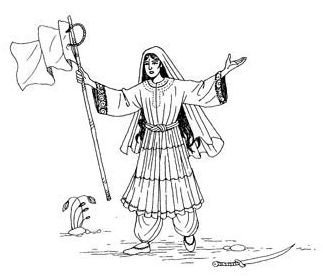
Malalai: the Joan of Arc of Afghanistan


When Malala Yousafzay was awarded the Nobel Peace Prize, I of course, had to scour the web to find some info on her. And you should check out my post “Malala Yousafzay and Kailash Satyarthi and the Nobel Prize 2014” to read about how and why she earned the prize. As I read about her, I came across a line that mentioned that she was named after Malalai, an Afghan heroine. So, off I went again in search of info on Malalai. I was all set to gather and collate and draft something, when I came across this blog by Garen Ewing, http://www.garenewing.co.uk/angloafghanwar/biography/malalai.php, which I happily share with you here! Indeed, I am happy to celebrate two young women (Malala and Malalai) who dedicated their lives to working for human rights!!


Malalai
Afghan heroine of Maiwand

While in Britain, no one has heard of her, in Afghanstan Malalai (or Malala) is a legend. Smaller facts in the story vary slightly, but although it is Ayub Khan who became known as the Victor of Maiwand, it is said that it was Malalai who actually saved the day.

She was a native of Khig, a tiny village on the edge of the Maiwand battlefield, and the daughter of a shepard. Both her father and fiancée joined with Ayub’s army in the attack on the British on July 27th 1880 (which some say was also her wedding day), and like many women, Malalai was there to help tend to the wounded and provide water and spare weapons. Eventually there came a point in the battle where the Afghan army, despite their superior numbers, started to lose morale and the tide seemed to be turning in favour of the British. Seeing this, Malalai took off her veil and shouted out:

“Young love! If you do not fall in the battle of Maiwand,
By God, someone is saving you as a symbol of shame!”

This gave many of the Afghan fighters and ghazis a new resolve and they redoubled their efforts. At that moment one of the leading flag-bearers fell from a British bullet, and Malalai went forward and held up the flag (some versions say she made a flag out of her veil), singing a landai:

“With a drop of my sweetheart’s blood,
Shed in defense of the Motherland,
Will I put a beauty spot on my forehead,
Such as would put to shame the rose in the garden,”

But then Malalai was herself struck down and killed. However, her words had spurred on her countrymen and soon the British lines gave way, broke and turned, leading to a disastrous retreat back to Kandahar and the biggest defeat for the Anglo-Indian army in the Second Afghan War. Ayub Khan afterwards gave a special honour to Malalai and she was buried at her village, where her grave can still be found.

British sources, unsurprisingly, do not mention Malalai. Her actions may not have been noticed by any of the British, or they may not have seemed as consequential as they were to the Afghans. Afghan women are very rarely mentioned at all in the reports and narratives of the war (Hensman mentions that one woman was found among the dead at Ahmed Khel). Interestingly, it is the Afghans who provide some of the evidence for one of the other legends born at the battle of Maiwand, as it is from one of Ayub’s artillery colonels that we learn some of the details of the famous last stand of the 66th, clutching to their company colours, in a Khig garden, where indeed the fallen bodies were later found to be lying.

As well as Malalai, there were many other factors in the Afgan’s favour on that day, including preferential terrain and positioning, superior numbers, skilled use of outnumbering artillery, and perhaps some bad decisions on the British side of things. But certainly her actions were enough to turn her into a national hero where she is still revered today. Schools, hospitals and even a women’s magazine have been named after her. It is also a popular girl’s name, with Malalai Joya a rare female voice in post-Taliban Afghan politics.

Article by Garen Ewing ©2005. Separate from other articles on this website, I grant a creative commons license so this article may be used elsewhere to spread the word about Malalai. Please include this credit line.


Malalai of Maiwand
Da_Maiwand_MalalaiA drawing of Malalai holding Ayub Khan’s flag at the battlefield of Maiwand in July 1880
Born 1861
Khig, Kandahar Province, Afghanistan
Died July 1880 (aged 18–19)
Maiwand, Kandahar province, Afghanistan
Nationality Afghan
Other names Malalai Nia, Malala and Malalai of Maiwand
Ethnicity Pashtun
Known for Battle of Maiwand


Something From Nothing

There is a wonderful story that is variously called something from nothing, or sometimes Sara’s coat. I’ve tweaked it a bit here and inserted Sophie, but the basic storyline remains faithful to a telling I found from Colin Gibson. At its core, this is a Yiddish story of transformations, of hope, of faith and of actions.

When Sara was a baby, her grandmother (who was a tailor) made her a wonderful coat to keep her warm and dry.

But as Sara grew older the wonderful coat grew older too.

One day her mother said to her, ‘Sara, look at your coat. It’s frazzled and it’s worn and it’s unsightly and it’s torn. It is time to throw it away.’

‘Grandma can fix it’, Sara said.

So Sara’s grandmother took the little coat and turned it round and round. ‘Hmmm,’ she said as her scissors went snip snap and her needle flew in and out,’ there’s just enough material to make a wonderful jacket. Sara put on the wonderful jacket and went outside to play.

But as Sara grew older the wonderful jacket grew older too.

One day her mother said to her, ‘Sara, look at your jacket. It’s shrunken and small, doesn’t fit you at all. It is time to throw it out.’

‘Grandma can fix it’, Sara said.

Sara’s grandmother took the jacket and turned it round and round. ‘Hmmm,’ she said as her scissors went snip snap and her needle flew in and out,’ there’s just enough material to make a wonderful vest. Sara put on the wonderful vest and wore it to school the very next day. She was so proud of it she wore it all the time.

But as Sara grew older the wonderful vest grew older too.

One day her mother said to her, ‘Sara, look at your vest. It’s spotted with glue and there’s paint on it too. It is time to throw it out.’

‘Grandma can fix it’, Sara said.

So Sara’s grandmother took the vest and turned it round and round. ‘Hmmm,’ she said as her scissors went snip snap and her needle flew in and out,’ there’s just enough material to make a wonderful tie. Sara wore the wonderful tie to her grandparents’ house every Friday.

But as Sara grew older the wonderful tie grew older too.

One day her mother said to her, ‘Sara, look at your tie. This big stain of soup makes the end of it droop. It is time to throw it out.’

‘Grandma can fix it’, Sara said.

Sara’s grandmother took the tie and turned it round and round. ‘Hmmm,’ she said as her scissors went snip snap and her needle flew in and out,’ there’s just enough material to make a wonderful button. Sara wore the wonderful button on her sweater to hold her to keep it close around her.

One day her mother said to hedr, ‘Sara, where is your button?’

Sara looked. It was gone.

She searched everywhere but she could not find it. Sara ran to her grandmother’s house. ‘My button, my wonderful button is lost!’ she cried. Her mother ran after her. ‘Sara, listen to me. The button is gone, finished, kaput. Even your grandmother cannot make something from nothing!’

Sara’s grandmother shook her head sadly. ‘I’m afraid that your mother is right,’ she said.

But the next day Sara went to school. ‘Hmm,’ she said as her pen went scritch scratch, scritch, scratch over the paper. There’s just enough material here to make a wonderful story.’

Colin Gibson reminds us that this is folktale which has inscribed on it the experience of a whole people, which acknowledges some of the difficulties of existence, and comes up with a gesture of hope and belief in the future. In a special way it offers a transformation or rather a series of transformations; it also suggests that we may yet bring life out of death.

Gibson point out that the world in which Sara lives is one of desperate poverty, in which any material goods must be made to last as long as possible. The world of Sara’s family overshadowed by two great evils all human beings experience in life: the inevitable losses brought about by the passage of time (coats are worn out, ties are stained with soup) and unfortunate accident (buttons are lost). They are evils most of us know from personal experience. The voice of Sara’s mother steadily acknowledges these sad truths: ‘it is time to throw it out, to throw it away. The button is gone, finished, kaput. Even your grandmother cannot make something from nothing!’ it is the voice of stoic realism. But the world of Sara is lightened by two great human values: the first is the power of loving social relationships (the girl’s love for and trust in her grandmother—’Grandma can fix it’— and the grandmother’s loving imagination, courage and creativity, forever winning something out of nothing. This is the voice of the tailor-grandmother, whose scissors went snip snap while her needle flew in and out. Through the imaginative experience of the story, there rings out the old human challenge to a hostile universe; the ancient Jewish belief in the race’s survival against all odds. The child has learned the wisdom of her grandmother; there is a trick left yet; the lost piece of cloth will be transformed in a story that goes on being sung to this day.

And I would ask you all to consider, where is social justice in this story? Where are human rights? Look between the lines my friends. They are woven in the fabric. They are the very something that we can all resuscitate, that we all must resuscitate, even from nothing with our own imagination, courage, creativity and persistence, forever claiming the precious dignity of each and every human being even from the seeming nothingness of unending daily degradations. We must each of us stand fast and be the tailors of each other’s respect and dignity.

Red Brocade by Naomi Shihab Nye

Red Brocade

Naomi Shihab Nye

The Arabs used to say,
When a stranger appears at your door,
feed him for three days
before asking who he is,
where he’s come from,
where he’s headed.
That way, he’ll have strength
enough to answer.
Or, by then you’ll be
such good friends
you don’t care.

 Let’s go back to that.
Rice? Pine Nuts?
Here, take the red brocade pillow.
My child will serve water
to your horse.

 No, I was not busy when you came!
I was not preparing to be busy.
That’s the armor everyone put on
to pretend they had a purpose
in the world.

 I refuse to be claimed.
Your plate is waiting.
We will snip fresh mint
into your tea. 

© 2002 by Naomi Shihab Nye, from 19 Varieties of Gazelle: Poems of the Middle East.


Naomi Shihab Nye was born on March 12, 1952, in St. Louis, Missouri. Naomi Shihab Nye was born in St. Louis, Missouri in 1952. Her father was a Palestinian refugee and her mother an American of German and Swiss descent Her father was a Palestinian refugee and her mother a Swiss-German-American . She spent her adolsecnece in Ramallah, Palestine; the Old City in Jerusalem; and San Antonio, Texas. Her experiences of cultural difference weaves throughout her writings. She is known for bringing a fresh perspective to the ordinary within her writing.

She earned her BA from Trinity University in San Antonio, Texas where she continues to live and work.

Naomi told Contemporary Authors: “ I have always loved the gaps, the spaces between things, as much as the things. I love staring, pondering, mulling, puttering. I love the times when someone or something is late – there’s that rich possibility of noticing more in the meantime . . . poetry calls us to pause. There is so much we overlook, while the abundance around us continues to shimmer, on its own.”

I hope you enjoy Naomi’s poem and that you go out and explore more of her writings. I hope we all take a breath and pause to notice the shimmer of abundance that surrounds us. . . . Let us pause and feed each other, nurture each other until we are such good friends that we don’t care about the past or the details, that we simply cherish the humanity and dignity of each other. Let us take the time to brew a cup of fairness and justice for each other even as we snip fresh mint for that tea.

Malala Yousafzay and Kailash Satyarthi and the Nobel Prize 2014

The Nobel Peace Prize for 2014

The Norwegian Nobel Committee has decided that the Nobel Peace Prize for 2014 is to be awarded to Kailash Satyarthi and Malala Yousafzay for their struggle against the suppression of children and young people and for the right of all children to education.  Children must go to school and not be financially exploited.  In the poor countries of the world, 60% of the present population is under 25 years of age.  It is a prerequisite for peaceful global development that the rights of children and young people be respected.  In conflict-ridden areas in particular, the violation of children leads to the continuation of violence from generation to generation.

Showing great personal courage, Kailash Satyarthi, maintaining Gandhi’s tradition, has headed various forms of protests and demonstrations, all peaceful, focusing on the grave exploitation of children for financial gain.  He has also contributed to the development of important international conventions on children’s rights.

Despite her youth, Malala Yousafzay has already fought for several years for the right of girls to education, and has shown by example that children and young people, too, can contribute to improving their own situations.  This she has done under the most dangerous circumstances.  Through her heroic struggle she has become a leading spokesperson for girls’ rights to education.

The Nobel Committee regards it as an important point for a Hindu and a Muslim, an Indian and a Pakistani, to join in a common struggle for education and against extremism.  Many other individuals and institutions in the international community have also contributed.  It has been calculated that there are 168 million child labourers around the world today.  In 2000 the figure was 78 million higher.  The world has come closer to the goal of eliminating child labour.

The struggle against suppression and for the rights of children and adolescents contributes to the realization of the “fraternity between nations” that Alfred Nobel mentions in his will as one of the criteria for the Nobel Peace Prize.

Oslo, 10 October 2014


 At 17, Malala is the youngest person ever to receive a Nobel Peace Prize. Here is a little bit about who she is and the work she is doing, from her web page http://www.malala.org/#1

Malala Yousafzay was born on 12 July 1997, in Mingora, the Swat District of north west Pakistan. She was named Malala, after Malalai, the famous Pashtun Heroine. Malala’s father, Ziauddin Yousafzai is a poet, and runs a public school. He is a leading educational advocate himself. In 2009, Malala began writing an anonymous blog for the BBC expressing her views on education and life under the threat of the Taliban taking over her valley. During this period, the Taliban’s military hold on the area intensified. As the Taliban took control of the area they issued edicts banning television, banning music, and banning women from going shopping and limiting women’s education. A climate of fear prevailed and Malala and her father began to receive death threats for their outspoken views. As a consequence, Malala and her father began to fear for their safety. After the BBC blog ended, Malala was featured in a documentary made for The New York Times. She also received greater international coverage and was revealed as the author of the BBC blog. In 2011, she received Pakistan’s first National Youth Peace Prize and she was nominated by Archbishop Desmond Tutu for the International Children’s Peace Prize. Her increased profile and strident criticism of the Taliban caused Taliban leaders to meet, and in 2012, they voted to kill her. On 9 October, 2012, a masked gunman entered her school bus and asked for Malala by name. Malala was shot with a single bullet which went through her head, neck and shoulder. Two of her friends were also injured in the attack. Malala survived the initial shooting, but was in a critical condition. She was later moved to Birmingham in the United Kingdom for further treatment at a specialist hospital for treating military injuries. She was discharged on January 3, 2013 and moved with her family to a temporary home in the West Midlands. It was a miracle she was alive. Ehsanullah Ehsan, chief spokesman for the Pakistani Taliban, claimed responsibility for the attack, saying that Yousafzai was a symbol of the infidels and obscenity. However, other Islamic clerics in Pakistan issued a fatwa against the Taliban leaders and said there was no religious justification for shooting a schoolgirl. Her assassination attempt received worldwide condemnation and protests across Pakistan. Over 2 million people signed the Right to Education campaign. The petition helped lead to the ratification of Pakistan’s first right to education bill. Her shooting, and her refusal to stand down from what she believed was right, brought to light the plight of millions of children around the world who are denied an education today. Malala became a global advocate for the millions of girls being denied a formal education because of social, economic, legal and political factors. She started the Malala Fund to bring awareness to the social and economic impact of girls’ education and to empower girls to raise their voices, to unlock their potential, and to demand change.


And, here is a bit about Kailash Satyarthi from his web page Kailash Satyarthi was born on January 11, 1954. He is a human rights activist from India who has been at the forefront of the global movement to end child slavery and exploitative child labor since 1980 when he gave up a lucrative career as an Electrical Engineer for initiating crusade against Child Servitude. As a grassroots activist, he has led the rescue of over 78,500 child slaves and developed a successful model for their education and rehabilitation. As a worldwide campaigner, he has been the architect of the single largest civil society network for the most exploited children, the Global March Against Child Labor, which is a worldwide coalition of NGOs, Teachers’ Union and Trade Unions. As an analytical thinker, he made the issue of child labor a human rights issue, not a welfare matter or a charitable cause. He has established that child labor is responsible for the perpetuation of poverty, unemployment, illiteracy, population explosion and many other social evils. He has also played an important role in linking the fight against child labor with the efforts for achieving ‘Education for All’.

The pessimist, the optimist, and the pony

In his quest to develop a theory of everything, Ken Wilbur reads widely, wildly, even wantonly. He is known to say that there is a kernel of truth in every theory. Everyone gets something right, so it is never appropriate to completely dismiss someone completely out of hand. (Of course the trick in this is discerning the wheat from the chaff, the good from the bad, the right/helpful from the wrong/the unhelpful.)

In that spirit, here’s a story attributed to Ronald Regan. I am not a huge fan of Ronald Regan’s politics. But, there is something about this story and the implications that the folks in his administration drew from it. Sure there are dozens of other versions of the story on the internet, but this one just kind of makes me smile. So, in the spirit of Pennsylvania’s Lackawanna County District Forester, Manny Gordon, I hope that you will “Enjoy, Enjoy, Enjoy!!”


Once upon a time, in a place where families dearly loved their children there were twin girls whose appearance evoked the comment “two peas in a pod” and whose personalities stood as polar opposites! The girls’ parents were worried that the girls were developing extreme personalities — one was a total pessimist, the other a total optimist — and so their parents took them to see a social worker. 

First the social worker opted to engage with the pessimist.  Trying to brighten her outlook, the social worker took her to a room piled to the ceiling with brand-new toys.  But instead of yelping with delight, the little girl burst into tears.  “What’s the matter?” the social worker asked, baffled. “Don’t you want to play with any of the toys?”  “Yes,” the little girl cried, “but if I did I’d only break them.” 

Next the social worker reached out to the optimist.  Trying to dampen her outlook just a bit, the social worker took her to a room piled to the ceiling with horse manure.  But instead of wrinkling her nose in disgust, the optimist emitted just the yelp of delight the social worker had been hoping to hear from her sister, the pessimist.  Then she climbed to the top of the pile, dropped to her knees, and began gleefully digging out scoop after scoop of poop with her bare hands.  “Would you share with me what you’re doing?” the social worker asked, just as baffled by the optimist as she had been by the pessimist. “With all this manure,” the little girl replied, beaming, “there must be a pony in here somewhere!” 


It is said that Ronald Regan told his version of this story so often, that whenever something went wrong one of his staff was sure to yell out, “There must be a pony in this somewhere.” That would break the tension, and the laughter would let them dig in with a fresh perspective and renewed energy. And sometimes that is just what our work for social justice and human rights needs – a respectful laugh break that enables us to come back with fresh energy and a different perspective.

So, keep looking for that pony, it’s got to be in there somewhere!!

On Becoming Real

Children’s playrooms can be fun filled places. They can also be fearsome rooms. They are often filled with elements of joy and delight, but they can also be places where monsters lurk and anxieties burble. In the world of Margery Williams, in her book the Velveteen Rabbit, on this day, the playroom is a place of sadness because The Girl is terribly ill and has not been allowed out of bed and into the playroom in a very, very long time. Here is a section from the book where we listen in on a conversation among the toys as they discuss becoming real.

 The Skin Horse had lived longer in the nursery than any of the others. He was so old that his brown coat was bald in patches and showed the seams underneath, and most of the hairs in his tail had been pulled out to string bead necklaces. He was wise, for he had seen a long succession of mechanical toys arrive to boast and swagger, and by-and-by break their mainsprings and pass away, and he knew that they were only toys, and would never turn into anything else. For nursery magic is very strange and wonderful, and only those playthings that are old and wise and experienced like the Skin Horse understand all about it. “What is REAL?” asked the Rabbit one day, when they were lying side by side near the nursery fender, before Nana came to tidy the room. “Does it mean having things that buzz inside you and a stick-out handle?” “Real isn’t how you are made,” said the Skin Horse. “It’s a thing that happens to you. When a child loves you for a long, long time, not just to play with, but REALLY loves you, then you become Real.” “Does it hurt?” asked the Rabbit. “Sometimes,” said the Skin Horse, for he was always truthful. “When you are Real you don’t mind being hurt.” “Does it happen all at once, like being wound up,” he asked, “or bit by bit?” “It doesn’t happen all at once,” said the Skin Horse. “You become. It takes a long time. That’s why it doesn’t happen often to people who break easily, or have sharp edges, or who have to be carefully kept. Generally, by the time you are Real, most of your hair has been loved off, and your eyes drop out and you get loose in the joints and very shabby. But these things don’t matter at all, because once you are Real you can’t be ugly, except to people who don’t understand.” “I suppose you are real?” said the Rabbit. And then he wished he had not said it, for he thought the Skin Horse might be sensitive. But the Skin Horse only smiled.                    “The Boy’s Uncle made me Real,” he said. “That was a great many years ago; but once you are Real you can’t become unreal again. It lasts for always.” The Rabbit sighed. He thought it would be a long time before this magic called Real happened to him. He longed to become Real, to know what it felt like; and yet the idea of growing shabby and losing his eyes and whiskers was rather sad. He wished that he could become it without these uncomfortable things happening to him.


And of course we all want to be real. How can we respect the dignity of others if we cannot respect our own dignity? And how can we respect our own dignity if we are not Real? Yet, like the Rabbit, we want to become real without all those painful things happening to us. But becoming real, to others and to ourselves, well it seems to me that that’s just what a life well lived is all about, and getting our sharp edges worn smooth, and having our hair loved off, and becoming a bit shabby, well that’s part of the process too.

So, listen, the rest of the book is quite wonderful, and finishes the story of the Rabbit becoming Real. Go have a read …  You can find the full text of the book at Project Guttenberg, http://archive.org/stream/thevelveteenrabb11757gut/11757.txt wherethe eBook is reproduced courtesy of the Celebration of Women Writers, online at http://digital.library.upenn.edu/women/.

Fools or the Wisdom of the Innocent

The Sioux people tell the story of a woman and her husband who had one daughter. The mother and daughter were deeply attached to one another with the love that comes from shared work and stories and the open hearted love of innocence. When the daughter died the mother was inconsolable. She cut off her hair, cut gashes in her cheeks and sat before the corpse with her robe drawn over her head, mourning for her dead daughter in the traditional way. In the depth of her grief, the mother would let no one touch the body to take it to a burying scaffold. She had a knife in her hand, and if anyone offered to come near the body the mother would wail:

“I am weary of life. I do not care to live. I will stab myself with this knife and join my daughter in the land of spirits.”

Her husband and relatives tried to get the knife from her, but could not. They feared to use force lest she kill herself. They came together to see what they could do.

“We must get the knife away from her,” they said.

After a time, a young boy of the village came to the tent of the grieving woman. He was an orphan and very poor, and was regarded as a bit of a fool by others. His moccasins were out at the sole and he was dressed in wei-zi (coarse buffalo skin, smoked). He said to her close relatives, “I will go into the tent and get the knife away from her.”

The others did not believe that he could accomplish this, but they were at a loss and did not know what else to try, so they gave him their permission to enter the tent to see what he might do.

The boy went to the tent and sat down at the door as if waiting to be given something. The corpse lay in the place of honor where the dead girl had slept in life. The body was wrapped in a rich robe and wrapped about with ropes. Friends had covered it with rich offerings out of respect to the dead.

As the mother sat on the ground with her head covered she did not at first see the boy, who sat silent. But when his reserve had worn away a little he began at first lightly, then more heavily, to drum on the floor with his hands. After a while he began to sing a comic song. Louder and louder he sang until carried away with his own singing he sprang up and began to dance, at the same time gesturing and making all manner of contortions with his body, still singing the comic song. As he approached the corpse he waved his hands over it in blessing. The mother put her head out of the blanket and when she saw the poor simpleton with his strange grimaces trying to do honor to the corpse by his solemn waving, and at the same time keeping up his comic song, she watched for a while, and then after some time she burst out laughing. She laughed until she began to cry. Then she reached over and handed her knife to the simpleton.

“Take this knife,” she said. “You have taught me to forget my grief. If while I mourn for the dead I can still be mirthful, there is no reason for me to despair. I no longer care to die. I will live for my husband.”

The simpleton left the tepee and brought the knife to the astonished husband and relatives.

“How did you get it? Did you force it away from her, or did you steal it?” they said.

“She gave it to me. How could I force it from her or steal it when she held it in her hand, blade uppermost. I sang and danced for her and she burst out laughing. Then she gave it to me,” he answered.

When the old men of the village heard the orphan’s story they were very silent. It was a strange thing for a lad to dance in a tepee where there was mourning. It was stranger that a mother should laugh in a tepee before the corpse of her dead daughter. The old men gathered at last in a council. They sat a long time without saying anything, for they did not want to decide hastily. The pipe was filled and passed many times. At last an old man spoke.

“We have a hard question. A mother has laughed before the corpse of her daughter, and many think she has done foolishly, but I think the woman did wisely. The lad was simple and of no training, and we cannot expect him to know how to do as well as one with good home and parents to teach him. Besides, he did the best that he knew. He danced to make the mother forget her grief, and he tried to honor the corpse by waving over it his hands.”

“The mother did right to laugh, for when one does try to do us good, even if what he does causes us discomfort, we should always remember the motive rather than the deed. And besides, the boy’s dancing saved the woman’s life, for she gave up her knife. In this, too, she did well, for it is always better to live for the living than to die for the dead. It is good to honor the dead, it is necessary to live on for the living.”


From McLaughlin, Marie L. (1916) who shared this story in honor of her mother Mary Graham Buisson from whom she first heard this story.


I like this story for so many reasons:

When I first read it through, inevitably I find myself smiling. And then as I breathe I find myself remembering the lesson to remember to see the good wishes that are so often nestled within the actions of others.

And then I remember the teaching that everyone is our teacher, and when the student is ready the teacher will be there which reminds me that even if the other person might not have had the friendliest of motives, there is still a good lesson in all of life’s encounters – if only I will pause long enough to find it and learn.

And then I remember the importance of honoring the dead and of living for the living – Ah, remember the Mother Jones quote, “pray for the dead and fight like hell for the living.” And so in love and laughter, let’s all go forward to live our lives like there will be no tomorrow, like there is eternity in the joy of now.

Stories and the Three Socratic Filters

Late in the autumn it was the annual visiting day at the Cloister of the Sisters of Mary Magdalene. Sister Beatrix was delighted to see that several of her sorority sisters from college had made the trek and were there to see her. They all gathered together in one of the gardens, settled in with some lemonade, and were ready to catch up on the events in each other’s lives.

Some time passed, and they filled Beatrix in on the births, deaths, dating and mating moments each of them had lived through since they had seen each other. They were ready to fill her in on some tidbits that they had heard about some of their other sorority mates when Beatrix remembered the postulants’ lesson from that very morning. She blushed a bit, but bravely held up her hand and said, “Hold on just a moment girls. I hate to be a wet dishrag in our re-bonding moment, but I’ve got to run this by you. Just this morning here in the cloister we were studying the Socratic Filters and”

“Wait Beatrix,” said one of the sorority sisters, “remember, I was a philosophy major! Don’t you mean the Socratic method?”

“Well, actually, I do mean the Socratic Filters. Here at the cloister, we pledge not to speak unless our words can pass through the three Socratic Filters. So, the first filter is truthfulness. Are you sure that what you are going to tell us is actually true?”

And the Georgina allowed as how she could not be certain because she heard the story from someone who had heard it from someone else.

Beatrix then continued, “Well, if you are not certain of the truthfulness, then is the story generous, good or kind?”

Georgina smiled, and said, “well, I don’t think I would say it is so kind, but it is juicy!”

Beatrix laughed shaking her head and said, “Well if you don’t know for sure if the story is true and it isn’t generous, good or kind, then there is still one more filter: is it useful or necessary for us to know?”

Georgina managed to scowl, smile and smirk all at the same time as she allowed as how there was not actually any utility in the story, other than giving them all a laugh, but at someone else’s expense.

And, Beatrix replied, “if the story is neither true; nor generous, good or kind; nor useful or necessary, let’s move on to something else that will cheer our minds, hearts and souls?”

Georgina thought about this for a minute, and managed to get out a bit of a laugh and said, well, I can see your point. I sure as shootin wouldn’t want someone saying that kind of stuff about me – even if it was true! Which of course it would not be, because I am a perfect little angel.

And they all had a good laugh at the thought of Georgina being an angel. To which she replied, “ah, but my friends, that statement passes the second Socratic filter, it is generous and kind!” And they all laughed even more deeply.

On aiding and abetting

On September 9, 2014 in his blog “People for Others,” Paul Brian Campbell, SJ posted this piece on The Meaning of Life. I have to say that I LOVE “People for Others.” (http://peopleforothers.loyolapress.com)  It is one of the few blogs that I follow and read regularly. And, this one, this one really just caught me at the very right moment and took my breath away and then brought it back again – and ain’t that just what being in-spired is all about?

So Paul wrote:

 In 1988, the publishers of Life magazine asked 300 “wise men and women” their opinions on the meaning of life.  Annie Dillard’s response had me from the first sentence.  It oozes an Ignatian sensibility:

We are here to witness the creation and abet it. We are here to notice each thing so each thing gets noticed. Together we notice not only each mountain shadow and each stone on the beach but, especially, we notice the beautiful faces and complex natures of each other. We are here to bring to consciousness the beauty and power that are around us and to praise the people who are here with us. We witness our generation and our times. We watch the weather. Otherwise, creation would be playing to an empty house.

According to the second law of thermodynamics, things fall apart. Structures disintegrate. Buckminster Fuller hinted at a reason we are here: By creating things, by thinking up new combinations, we counteract this flow of entropy. We make new structures, new wholeness, so the universe comes out even.

Don’t you just love the notion of “abetting” creation?

 As he loves the notion of abetting creation – and I do to – even more I like the notion of abetting, of aiding and abetting progress towards human rights. So today, this day, let us all notice, and aid and abet, human dignity where ever we may find it, in the small places, close to home, close to our hearts.

The Identity of Mullah Nasser-E-Din and the Jar

 Once upon a time many of the souls in Afghanistan enjoyed the peace and joy of village life. Mullah Nasser-E-Din was a well known wise man throughout the villages, and is the central character in many tales of wisdom throughout Afghanistan, Israel and Turkey.

It is said that one day Mullah Nasser-E-Din went to the public baths. As he strolled through the bath, he thought to himself that it indeed would be lovely to dip into the waters and take off a few layers of sand and dirt. So, in he went and he washed himself from head to toe. As he emerged all clean and refreshed, he noticed that all the bathers were lying on the floor having a bit of a mid-day nap, rending the ceiling and the sky with their snores. He said to himself: “How good it would be to fall into a sweet sleep!” But he thought, what could he do so as not to be exchanged for a neighbor? What if someone stole his identity while he was sleeping. (Here we have a fabulous example of the prescience of Mullah Nasser-E-Din – he knew to worry about identity theft even then!) He took a jar, put his identity into it and fastened it to his waist, and fell asleep.

In the meantime one of the sleepers woke up and saw the jar fastened to Nasser-E-Din’s waist. He coveted the jar, took it, and fastened it to his own waist. After a short time, Nasser-E-Din arose and saw that the jar was not there. He looked around, and lo! There it was, fastened to the waist of someone else. He woke him up and said, “My friend, if I am I, where it the jar? But if you are me, who am I?”


When I first found this folk tale from Afghanistan in Josepha Sherman’s book of World Folklore, , I was completely taken with it. Then I reread it and didn’t get it at all. Then I read it again and thought about all of the ‘things’ that I have that I just wouldn’t really be me without (books came to mind first) and so then I think I got it again. Of course we don’t put our identities in a jar, but oh, do we ever tie them up in other things – possessions, relationships, work … and this little story was a nice reminder for me to just let it go, let it go, let it go …