My encounter with The Peace of God // Grief

On Wednesday February 5, 2020, Washington, DC was enjoying a balmy 50°F, with cloudy skies that were producing an on again off again heavy mist.

(A month later on March 11 the World Health Organization declared Covid-19 a pandemic, on Friday March 13 the President of the United States declared a national emergency, on March 14 CDC issued a “No Sail Order” to all cruise ships, and on March 15 states began to shut down schools, bars, restaurants and places of employment to prevent the spread of COVID-19. We all discovered zoom, grocery shopping online and home food delivery).

But on February 5 was I was blissfully ignorant of what was waiting just beyond the turn of a calendar page.

On that Wednesday, we were on a scavenger hunt looking for Rock Creek Cemetery, and for Augustus Saint-Gaudens’ sculpture commemorating Clover (Marian Hooper) Adams.

But why? When I was doing research for my novel, “Letters from Eleanor Roosevelt” I learned that in 1918, during one of the most trying times in Eleanor Roosevelt’s life, when she discovered Franklin had been carrying on with someone else, they were living in Washington DC, and she found great solace in Rock Creek Cemetery. Mrs. Roosevelt spent hours gazing at a statue by Augustus Saint-Gaudens in that cemetery.

Henry Adams commissioned the sculpture in memory of his wife, Clover, who committed suicide. In her book, “Clover Adams: A Gilded and Heartbreaking Life” Natalie Dykstra says that Henry Adams instructed Augustus Saint-Gaudens to take his inspiration from two sources: Michelangelo’s frescoes of the five seated Sibyls in the Sistine Chapel and images of the Buddha, especially Kwannon, the goddess of mercy. Saint-Gaudens notebook for the sculpture notes: mental repose, calm reflection in contrast with the violence or force of nature, beyond pain, beyond joy.
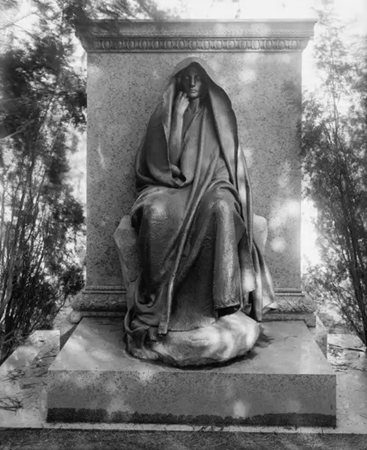
during one of the most trying times in Eleanor Roosevelt’s life, when she discovered Franklin had been carrying on with someone else, they were living in Washington DC, and she found great solace in Rock Creek Cemetery. Mrs. Roosevelt spent hours gazing at a statue by Augustus Saint-Gaudens in that cemetery.

The statue is a hooded figure about 6 feet tall, sitting on a rough-hewn granite block, deep in contemplation. The hood of the cloak drapes over all of the figure except the face. A large slab of polished red marble forms a background for the figure. At a bit of a distance away from the statue, there is a marble bench—the bench where Mrs. Roosevelt sat and contemplated the statue and her own future. There is no plaque on the statue, but Henry Adams called it ‘Peace of God,’ but most people know it as ‘Grief.’

The more that I read about the statue, the more I wanted to see it. It took a little time to convince my wife that this might be a worthwhile adventure, but finally, we were on our way in search of Rock Creek Cemetery and the statue. Neither was easy to find. Neither was well marked, but trusty GPS and persistence got us to both. It was worth the effort. The statue is starkly beautiful, cloaked in an aura of mystery, dignity, and solace. I’m glad that we made the trip. The memory of being in the presence of that statue carried me through the months ahead.

But my searching was not finished. I had to know more about Clover Adams. Usually I can uncover a wealth of information on the internet for the women I blog about here. But not so much for Clover (Marion Hooper) Adams. She was not a very public person. But, you have to be asking, then why did she warrant such a very public and grand memorial? Well, therein lies a story.

To be continued next week.

May I introduce Clare Boothe Luce?

My first experience of Clare Boothe Luce was her toast to Eleanor Roosevelt at Mrs. Roosevelt’s 70th birthday party, “Here’s to Eleanor. No woman has ever so comforted the distressed, or so distressed the comfortable.”

I was smitten. Who was this woman who conceived such an eloquent epigram, encapsulating the essence of Mrs. Roosevelt’s life works? I had to know more!

Ah, the power of reading! I learned that Ms. Luce was an American writer, politician, U.S. ambassador, and public conservative figure. Ah, but she was so much more. I learned that Clare Boothe Luce was born on March 10, 1903, in New York city to William Boothe and Ann Clare Snyder. Both of her parents were involved in the theater, and to help pay the bills, young Clare performed in several plays and did not begin her formal schooling until she was 12. As she grew and matured, Ms. Luce became known for her intelligence, wit, and a knack for publicity that, along with her celebrity and beauty, made her a media darling.

As a young adult, Clare set her sights on writing, the publishers of Condé Nast hired her at Vogue. By 1933 she served as the managing editor at Nast’s Vanity Fair magazine. On November 21, 1935, Clare Boothe married Henry R. Luce, founder of TimeLife, and Fortune magazines. Shortly thereafter Clare Boothe Luce came into her own as a successful playwright.

In 1936 she wrote a Broadway hit, The Women, a satire about the lives of Manhattan socialites that features an all-female cast. The play was made into a movie in 1939 starring Rosalind Russell and Joan Crawford (and was remade in 2008, featuring Meg Ryan and Annette Bening).

Clare began to develop an interest in politics during the Great Depression. When war broke out in Europe, she toured the world as a Life correspondent and reported on countries in Europe, Asia, and Africa and interviewed such famous people as Nehru and Chiang Kai-Shek.

Her first active participation in Republican politics came with her energetic support of Wendell Willkie’s 1940 presidential campaign. By 1942, Connecticut political leaders lobbied Luce to run for a U.S. House seat encompassing Fairfield County and the wealthy town of Greenwich, where Luce had a home. Luce based her platform on three goals: “One, to win the war. Two, to prosecute that war as loyally and effectively as we can. Three, to bring about a better world and a durable peace, with special attention to postwar security and employment here at home.”

Luce won a Connecticut U.S. House seat in 1942, despite never having stood for elective office. She served in the House of Representatives for two terms, the 78th Congress (1943–1945), and the 79th Congress (1945–1947). Though she was critical of President Franklin D. Roosevelt (FDR), Luce’s internationalist bent led her to back the broad outlines of the administration’s plans for the postwar world. She once described her philosophy as, “America first, but not only.” And, despite her status as a leading GOP spokesperson, Luce voted to support the general outlines of FDR’s foreign policy.

On domestic policy, Congresswoman Luce was centrist. In 1943 she supported the Equal Rights Amendment on the twentieth anniversary of its introduction in the House. Luce also endorsed the development of the Women’s Army Auxiliary Corps, arguing that, “We have always been fighting women and never afraid to do our part.” She advocated a heavy wartime tax on the rich: “those who can afford it, the well-to-do and the rich, must be taxed almost to the constitutional point of confiscation.” 

Republican Party leaders selected Luce as the keynote speaker at the 1944 Republican National Convention in Chicago, the first woman so honored by either party.

In 1946 Luce introduced a bill to create a Labor Department bureau to ensure women and minority workers equal pay for equal work. Clare Boothe Luce became the first woman ambassador ever appointed to a major diplomatic post. Luce left Italy in 1956 after suffering arsenic poisoning, and in 1959 she was nominated to be Ambassador to Brazil.

In 1973, Richard Nixon named Luce to the President’s Foreign Intelligence Advisory Board. President Reagan awarded her the Presidential Medal of Freedom, the first woman member of Congress to receive the award.

Clare Boothe Luce died in Washington, DC on October 9, 1987 at age 84 having left her mark on our world, having blazed new trails for the women who would follow stand on her shoulders. She has left us a legacy of strong and sturdy shoulders.

May I introduce Charlotte Perkins Gilman?

Spring is in full bloom and summer is right around the corner. Picnic time is with us. Imagine, if you will, a wide sweeping lawn, with maple and oak trees around the borders that give just enough shade so the sun is not oppressive. Imagine a table set for five. My wife and I, you and your sweetheart, and—and I think this week I would like to invite Charlotte Perkins Gilman to join us.

May I introduce her to you?

Born in Hartford, Connecticut, on July 3, 1860, her mother raised her with the help of Charlotte’s three aunts: Isabella Beecher Hooker, a suffragist; Harriet Beecher Stowe, author of Uncle Tom’s Cabin; and Catharine Beecher, educationalist.

She attended the Rhode Island School of Design, and for a time supported herself as an artist of trade cards (precursors to business cards, with illustrations and information about merchants and their business). She also worked for a time as a painter, a tutor, encouraging others to expand their artistic creativity. During this moment in her life, Charlotte met Martha Luther. Charlotte described their relationship as being: “closely together, increasingly happy together, for four of those long years of girlhood. She was nearer and dearer than any one up to that time. This was love, but not sex … With Martha, I knew perfect happiness …” In these early years of her adult life, Charlotte was happy. Never take happiness for granted.

Charlotte had two husbands and one daughter. Profound postpartum depression followed the birth of her daughter in 1885. Charlotte left much of the raising of their daughter to her first husband, but she maintained an ongoing relationship with her daughter. Charlotte lived life on her own terms, but those terms and that life were not always easy. At one point, Charlotte supported herself by selling soap door to door.

In 1888, she moved to Pasadena, California, with her friend Grace Channing. In Pasadena, her depression began to life. She worked with the National American Woman Suffrage Association, and the International Socialist and Labor Congress, and Nationalist Clubs movement (which worked to “end capitalism’s greed and distinctions between classes while promoting a peaceful, ethical, and truly progressive human race”).

In 1890, the Nationalist magazine published her poem “Similar Cases” (a satirical review of people who resisted social change), and that launched her writing career. 1890 was a watershed year for Charlotte. She wrote fifteen essays, poems, a novella, and a short story.

Between June 6 and 7, 1890, in her home in Pasadena, Charlotte wrote the short story, The Yellow Wallpaper. The New England Magazine printed it a year and a half later in the January 1892. That short story is now the all-time best-selling book of the Feminist Press. In the story, a man rents a cottage for the summer. His wife is trying to deal with her depression, so he locks her in a bedroom, and she, well, she sort of goes crazy. Maybe. Or maybe she finds an alternate reality. If you have not read The Yellow Wall Paper, just stop what you are doing, go to your local book store (or the Feminist Press web page), buy a copy, sit down and read it. It will creep you out. It will make you angry. And it will inspire you to action! (do be careful, reading can do that!).

The short story, The Yellow Wallpaper, is why I want to invite Charlotte Perkins Gilman to our picnic. I really want to know what motivated her to write this story. What was she thinking? How autobiographical was it?

Please do read it—but not when you are alone. Maybe read it on a sunny summer day, on the beach together with some like-minded friends, so you can talk about it with those friends over some hot dogs and s’mores.

Just to finish Charlotte’s life, she published her first volume of poetry, In This Our World, in 1893 and gained public recognition. She eventually became a successful lecturer and her speeches to activists and feminists became a primary source of income.

In 1932, Charlotte learned she had inoperable breast cancer.

In both her autobiography and a suicide note, she wrote that she “chose chloroform over cancer” and she died quickly and quietly on August 17, 1935. Reflecting on death she said, “Death? Why all this fuss about death? Use your imagination, try to visualize a world without death! Death is the essential condition to life, not an evil.”