May I Introduce Cecilia Payne Gaposchkin

Cecilia Payne Gaposchkin is high on my list of people I wish I could invite to a dinner party. She was a diligent, dedicated, hardworking woman and a world class astronomer.

Cecilia Payne Gaposchkin was born on May 10, 1900, in Wendover, Buckinghamshire, England, and died on December 7, 1979 in Cambridge, Massachusetts. And oh, what a life she lived in those 79 years. She was the first person to earn a PhD in astronomy from Harvard University. She was the first woman to become a professor in her department and the first woman to become a department chair at Harvard. In 1976, the American Astronomical Society awarded her the Henry Norris Russell Prize, its highest honor, in recognition of her lifetime of excellence in astronomical research.

But the prizes and accolades at the summit belie the obstructions and obstacles in the climb. Gaposchkin began her academic studies in Cambridge, England, in the 1920s. She prohibited from sitting in the same rows of seats as her male classmates. The University prohibited her from receiving a degree. Even though she fulfilled all the requirements, women were only granted ‘certificates.’

In 1923, she moved to the United States and began her studies at Harvard, where she completed her PhD in 1925. Her dissertation showed that helium and hydrogen were the most common elements in the stars and in the universe. That contradicted the scientific consensus of the time, and her findings were highly controversial. Her work was dismissed, and she took on less prestigious, low paying research jobs at Harvard. But she worked, and she worked in her chosen field. (Her discovery was later credited to Henry Norris Russell of Princeton University, who reached the same conclusion by different means. Gaposchkin’s role in the discovery remained in the background for decades.) But she worked, and she worked in her chosen field. Eventually, she claimed some small measure of recognition.

I highly recommend her autobiography for her personal views on her life, and to taste both her brisk style and her ability to communicate both complexity and nuance.

Reflecting on the way her dissertation findings were treated, Gaposchkin said, “I was to blame for not having pressed my point. I had given in to Authority when I believed I was right. That is another example of How Not To Do Research. I note it here as a warning to the young. If you are sure of your facts, you should defend your position.”
When asked for advice, Gaposchkin often said: Do not undertake a scientific career in quest of fame or money. There are easier and better ways to reach them. Undertake it only if nothing else will satisfy you; for nothing else is probably what you will receive. And yet, there is nothing personal in the thunderclap of understanding. The lightning that releases it comes from outside oneself. Your reward will be the widening of the horizon as you climb. Indeed, the reward of the young scientist is the emotional thrill of being the first person in the history of the world to see something or to understand something. Nothing can compare with that experience. The reward of the old scientist is the sense of having seen a vague sketch grow into a masterly landscape. If you achieve that reward, you will ask no other.

How I wish I could sit with her, share an evening and a glass of wine, and explore the contours of her mind.
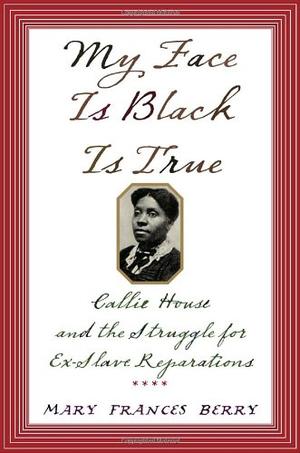
I would like you to meet Callie Guy House

Of all the women, living and dead, that I might invite to a dinner party, Mrs. Callie Guy House (Born approximately 186, died 1928) is at the top of my list. Mary Frances Berry introduced me to Mrs. House in her biography of this amazing woman, My Face Is Black Is True: Callie House and the Struggle for Ex-Slave Reparations. Let me just say right up front, you should go read the book! Mary Frances Berry makes history come alive. She will make you wish you could claim Callie House as your ancestor.

Here are some highlights from Mrs. House’s life story.

Mrs. House was born a slave, died a free woman. She was in Tennessee in January 1865 when William Tecumseh Sherman issued his order for each adult freed male slave to claim 40 acres. She cheered when the Freedman’s Bureau promised each freed man 40 acres and then wept when President Jackson pardoned the rebels and restored their lands to them, taking away the possibility of land for freed slaves.

Along with Mr. Isaiah Dickerson, Mrs. House championed the ex-slave movement. Forty acres and one mule for three hundred years of hard work with no pay—that was not too much to ask. Mrs. House and Mr. Dickerson argued that if the government had the right to free the slaves, then the government had a responsibility to ensure provisions for them. She argued that our government made promises at Emancipation and those promises should be fulfilled.

In 1896, House and Dickerson formed the National Ex-Slave Mutual Relief, Bounty and Pension Association. Mrs. House must have been a force of nature as she held forth on the needs and the rights of the ex-slaves. She traveled all over the south talking to groups of freed slaves. She talked to people who were struggling to keep body and soul together. She listened to people who were turned loose — People who were illiterate, barefooted, and naked without a dollar or a pocket to put it in; people who were free but with no place to go for shelter from the wind and rain. She listened to people who were free from the man who once had the power to whip them to death, but who were still dependent on that same man who now had the power to starve them to death. Today, we argue for freedom as a prized state of being. But for the people Callie House met with, freedom meant loss. The Ex-Slave Association gave them hope. They contributed monthly dues and helped each other out with illnesses and with burials. They sent petitions to Congress. Their petitions went unanswered. 

The late 1890s were many things, but they were not a time of benign neglect. In 1899, the Post Office issued a fraud order against the National Ex-Slave Mutual Relief, Bounty and Pension Association and its officers. The Post Office said that the Association and the officers could no longer use the mail because they were collecting moneys for fraudulent purposes. The Post Office kept obstructing their work. They made it difficult to collect the dues that kept the offices running. They made it difficult to put out newsletters and notices to the members. Even so, the Association found ways to struggle along. They used Wells Fargo and American Express. They used their brothers’ and sisters’ names.

But institutions are resilient and persistent and have power. On August 1916, the police arrested Mrs. House. For 20 years, she exercised her constitutional right to petition the government and taught other ex-slaves to do the same. But the Post Office accused her of using the mail to defraud people. They sent her to prison for a year. Callie House was resilient and persistent. But human beings have limits. By the time she got out of prison, the association was dead. Mrs. House was free, but she was too broken and too tired to do more than take in washing and sewing. She earned barely enough to put food on her plate. It was time for others to take up her cause. It IS time for others to take up her cause.